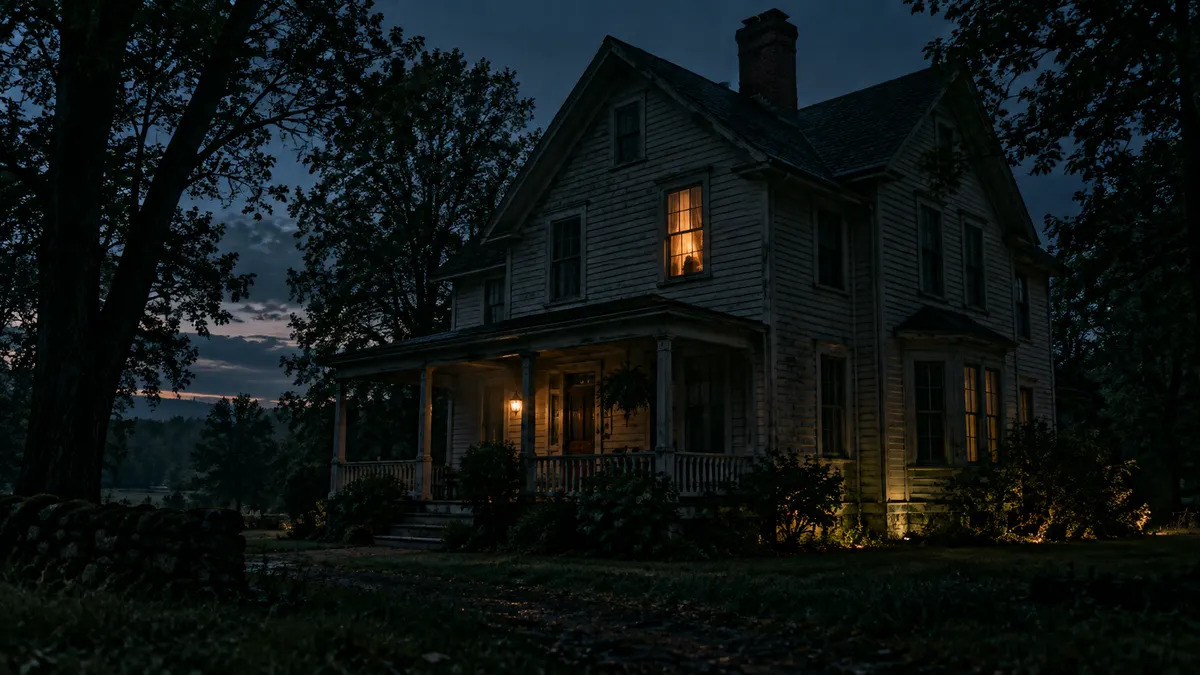
The real estate agent told them the house "had a personality." What she didn’t say was that it had lungs. The first night, Sam pressed his palm to the bedroom wall and felt it push back — warm, slow, patient, like something taking a breath before it speaks.
A little room to grow
He left his hand there until the movement stopped. Somewhere downstairs, his wife broke a glass. The sharp sound traveled through the wall beneath his palm, arriving before he heard it through the open door. “I’m fine,” Claire called. “Just one of the cheap ones.” Sam had the uncomfortable impression that the house relaxed. He took his hand away and went downstairs to help sweep up the pieces.
They had moved because the apartment was too small for a second child. Their daughter June needed a room of her own, Claire needed somewhere to put her desk, and Sam needed a reason to believe the next year would be easier than the last. The house offered all of those things for a price they could explain only by pointing out its distance from town.
The previous owner had lived there alone. According to the agent, she had died peacefully in her sleep. Her furniture was gone, but pale rectangles remained on the walls where photographs had hung. June followed them from room to room as if they formed a trail. At the end of the upstairs hall she found a door without a handle. Sam said it was probably a linen closet.
June put her ear against it. “Someone is trying to be quiet.” She was six, old enough to know that a sentence like that would get her father’s attention. Sam tapped the panel and heard solid wood. He promised to ask the agent for a key. When he bent to kiss June’s head, he noticed that the air beside the door was warmer than the air in the hallway.
At dinner the kitchen window misted over from the outside. Claire said the forecast called for a cold night. Sam watched a clear oval appear in the condensation, just above the sill, then vanish. It resembled the place a mouth might make against glass. He pulled the blind before June could see it. Nobody mentioned that the heating had not yet been switched on.
The inspection
By the third night, they all knew the rhythm. An intake lasting eleven seconds. A pause. An exhale lasting nine. The floorboards rose slightly on the intake; the bedroom doors leaned against their latches on the exhale. Claire recorded it on her phone. In the morning, the recording contained only the sound of her own breathing, much slower than she remembered it being.
Sam called a contractor who had worked on the house years earlier. He arrived with a moisture meter and a paper cup of coffee, then left the coffee on the porch without drinking it. In the crawlspace he found ordinary brick piers and dry earth. In the attic he found gray wool packed along the wall above the sealed room. He came down with a long strand caught on his sleeve.
“Insulation,” he said, pulling it off before Sam could touch it. He recommended opening the windows in every room and keeping the family elsewhere until he could arrange a second opinion. Sam asked whether the foundation was unsafe. The contractor looked toward the upstairs hallway. “I didn’t say foundation.” On his invoice he wrote: Remove improvised wool insulation. Restore ventilation. He would not start work with a child in the house.
Claire wanted a hotel. Sam wanted to understand what he would be telling the insurance company. Their argument was quiet, conducted over boxes they still had not unpacked. As Claire raised her voice, the ceiling lifted with an intake. As Sam answered, the house exhaled. June sat on the stairs watching them, her chest moving in time with the floor.
They stopped speaking at the same moment. June stopped breathing. Claire crossed the kitchen so quickly that a chair fell. She touched the child’s shoulders and said her name. The wall gave a deep, trembling shudder. June gasped, coughed, and looked startled by their faces. “I was listening,” she said. Behind the door without a handle, somebody knocked once.
The woman who stayed
They spent that night in a motel. June slept normally. Sam lay awake listening to the air conditioner and trying to distinguish its cycle from the rhythm he had brought with him. In the morning Claire drove June to her sister’s house. Before they left the motel, June had briefly fallen into the eleven-second rhythm again. Distance had not broken it. Sam returned alone for their closing plans, hoping to find what lay behind the sealed door; Claire stayed with June until her sister could take over. He brought a crowbar and promised not to open the room until he understood its layout.
The house smelled of warm milk. Every window was open an inch, including the ones he had never been able to budge. A pale dust covered the dining table. In it, someone had drawn a rectangle, a smaller rectangle inside it, and a line between them. Sam recognized the upstairs hallway. He also recognized the square that should have been the linen closet. On the closing plans, that square did not exist.
He visited the county records office instead of opening the door. The previous owner’s name was Evelyn Vale. In an old photograph attached to a permit, she stood on the porch holding a baby wrapped in a gray wool blanket. The permit requested an addition: one bedroom, insulated, independently heated. A second document canceled the work before construction. The date was four days after the child’s death.
The clerk found an envelope of correspondence. Evelyn had complained for years that the house cooled too quickly whenever she left. She wanted thicker walls, fewer windows, a way to keep a particular room warm through winter. One handwritten page asked whether a house could be made airtight. Beneath it, an inspector had written: Occupant advised that sealing all ventilation is incompatible with habitation.
Sam copied the sentence because he could not stop reading it. Evelyn had remained in that house for fifty-two years. The agent had said she died in her sleep, but the death notice mentioned a neighbor who found her on the porch at dawn, wrapped in a blanket, smiling at an upstairs window. There was no mention of the baby. There was no mention of anyone else inside.
The room without a door handle
When he returned, Claire’s car was in the driveway. She stood in the hall holding June’s stuffed rabbit. Her sister had called to say June was asking for the rabbit in her sleep, then repeating, “Open his window.” Claire had come to warn Sam that whatever he was investigating could still reach June. Her sister remained with the child, ready to call an ambulance. They met beneath the sealed door, each carrying the kind of small useful thing that had once made them good at being parents.
The house inhaled. Through the panel they heard a baby begin to cry. Claire put a hand on her belly. Sam pulled the crowbar from his coat and fitted it into the gap beside the frame. The wood yielded immediately. There were no nails holding the door shut. Something soft behind it had been pressing it into place. When he withdrew the bar, its tip was wet and warm.
They backed down the stairs. The crying followed through the plaster, moving faster than they did. In the kitchen, every empty cupboard stood open. The sink held a shallow pool of clear water. Beneath its surface lay the pieces of the glass Claire had broken on their first night. They fitted together perfectly, the bowl whole except for a narrow opening at the rim.
Claire said the house was repairing things. Sam thought of Evelyn, of the canceled bedroom, of a woman spending half a century trying to correct a room’s temperature. He thought of June learning the breathing pattern and of the second heartbeat Claire had let him hear at the hospital. “It doesn’t know the difference,” he said. “Between keeping something alive and keeping it here.”
A floorboard lifted under Claire’s shoe. She stepped away, and another lifted ahead of her. The house was not trying to trap their feet. It was showing them a direction, one board at a time, toward the nursery they had chosen for the new baby. From beneath that room came a sound unlike crying. Three deliberate knocks, a pause, then three more. Somebody asking to be let out.
The breath it could not finish
Sam’s phone rang. Claire’s sister said June had fallen asleep again and would not wake when called. She was breathing, but strangely: eleven seconds in, a long pause, nine seconds out. They had already called an ambulance. Sam told her to take June outdoors, away from every wall she could reach. The line crackled. Behind his sister-in-law’s voice, he heard the familiar complaint of their own front door.
Outside, every tree along the property leaned toward the roof. Sam could see the place where the contractor had left his paper cup. It lay on its side, untouched by the wind. The air was being drawn through the house so slowly that nothing loose moved, yet the pressure in his ears grew painful. Claire tried the front door. It opened easily. Beyond it lay their upstairs hallway. Through the kitchen window, however, Claire could still see their car beside the low garden wall. She raised the sash; it would rise only an inch, but the crowbar could break the glass.
Sam shut it before she stepped through. They stood holding hands while the house began another intake. Eleven seconds passed. Then fifteen. The walls kept moving. Somewhere inside them, a child was trying to take a breath larger than any child’s lungs could hold. The knocking beneath the nursery grew faster. Upstairs, the handleless door swung inward by the width of a finger.
Through the gap came a voice worn thin by years of whispering. “Please,” it said. “I only wanted somewhere warm.” Sam could not tell whether the voice belonged to Evelyn or to the thing she had taught the house to keep. In his hand the phone remained open to June’s silence. Claire looked toward the front door, then the nursery floor, then the opening upstairs. The house was still breathing in.
What they let go
Claire took the phone. Her sister was outside now, with June on the lawn and the ambulance turning into the street. “Stay with her,” Claire said. “Tell us when she breathes.” Then she put the rabbit on the kitchen sill, marking the window that still opened onto their own garden. She would make an exit there. Sam would open the room upstairs. They said the plan aloud so that neither could mistake the knocking for the other asking for help.
Sam pushed through the handleless door. Gray wool lined the frame, unraveling from a blanket like the one in Evelyn’s photograph. Behind it stood a cot. Above the cot, a small window had been covered with layers of timber; each board bowed inward. There was no baby in the bed. There was an impression in the mattress, held open by the same long intake that was holding June’s chest still.
The knocks rose through the heating pipe beside the cot. Each came when the little window strained against its boards. Nobody was trapped beneath the nursery. The house had been carrying the sound through its bones. Sam hooked the crowbar under the lowest board. “You can’t keep him warm anymore,” he said. The mattress deepened, and from downstairs Claire called that the paramedics had reached June.
The first board came away with a scream of nails. Cold air touched the cot. For a moment Sam saw a woman kneeling there, pressing wool into every crack with bleeding fingers. He wanted to stop tearing apart the only thing she had left. Then he heard his daughter’s name through the phone. He pulled the remaining boards free and broke the window. The impression in the mattress rose flat. The woman reached into the empty cot, opened her hands, and was gone.
The house exhaled. Claire smashed the kitchen pane with a chair, padded the sill with her coat and climbed into the garden. Sam followed her through it as the upstairs ceiling sagged. Behind them the nursery folded into the room below. Every repair the house had held together let go at once. Their savings, their new home, the room for the baby: none of it could be carried through that window.
On the phone June coughed. Then she cried, taking quick, uneven breaths that belonged to her alone. By the time her parents reached the hospital, she was awake and asking for her rabbit. Claire handed it over with a stripe of plaster dust still on one ear. Sam sat beside the bed until morning without counting a single breath. The agent had called the house a place with personality. What it had possessed was a habit of refusing an empty room. This time, they had left it one.
YOUR TURN · NO SIGN-IN NEEDED
What should happen next?
Each Wednesday the next chapter follows readers’ leading choice; when the vote is close, the editors decide using readers’ choices and ratings.
- 1. Choose what happens next
Published by LiveLore · AI-assisted fiction · human-reviewed
Join the story-update list below. Email dispatches have no confirmed schedule; you can remove your address using your private unsubscribe link.
← Back to the stories