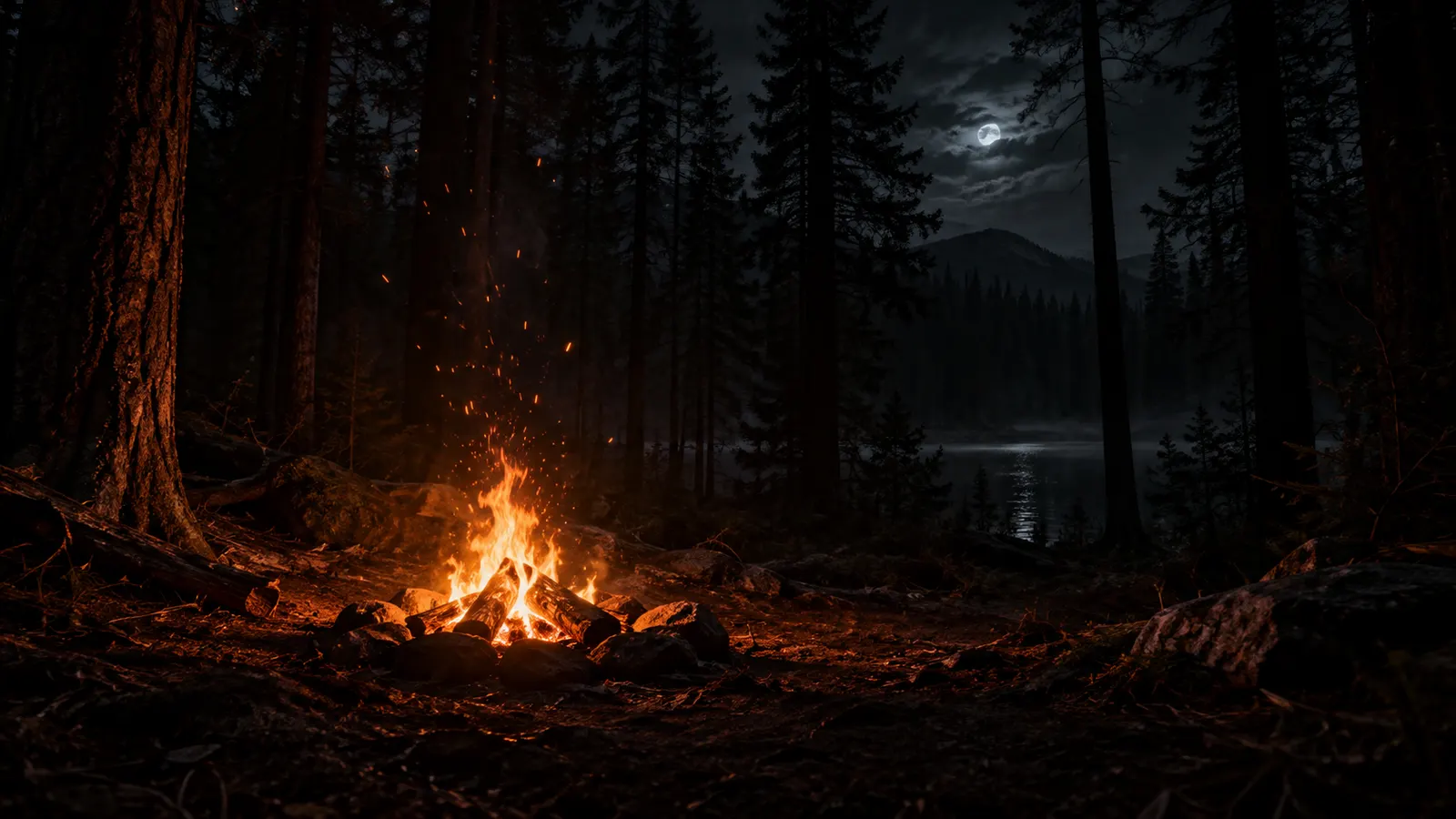
Chapter Three follows Dana back to Fallow Lake with the ranger, in daylight, to look for the record Miriam Bell left behind.
The Keeper's Shed
The ranger came for her on Wednesday afternoon, which was the first thing Dana liked about him. He did not pick a weekend, when the lake would be full of people. He parked at the end of her street, waited in the truck with the engine running, and did not honk. When she climbed in, he handed her a flashlight that was heavier than it looked. “Your own light,” he said. “Rule one.”
Her father had argued for an hour the night before. In the end he had not said yes so much as stopped saying no. He made the ranger promise they would be off the water before sunset, and he made Dana promise to text him every thirty minutes. She set an alarm on her phone for each one. She did not tell him that she had already read the four rules so many times she could see them with her eyes closed.
The ranger’s name was Owen Hale. He drove the lake road slowly, as if the trees might step out in front of him. He did not turn on the radio. When they passed the barrier he had put across the campsite track, Dana saw that someone had moved it six inches to the side, exactly enough for a person to slip past. Hale looked at it and kept driving. “Kids,” he said, without sounding as if he believed it.
The keeper’s shed stood on a low rise north of the boat launch, almost swallowed by blackberry canes. Its roof had been patched with three colors of tin. A padlock hung from the door, rusted into a single brown lump. Hale did not try the key. He cut the hasp with a pair of bolt cutters from the truck bed and said, “I’ve been meaning to do that for twenty years.”
Inside, it smelled of oil, wet rope and mice. Light came in through a crack in the north wall in a single gold stripe. There were life rings stacked like plates, an oar with a split blade, a calendar from a year when Dana’s mother had been in school. On a shelf above the workbench stood a row of empty lamp hooks. Every one of them faced the window that looked over the water.
A Tin Under the Floor
They searched the obvious places first. The drawers held fuses and fishing line. A filing box held tide tables for a lake that had no tides, which made Hale laugh once, quietly. Dana texted her father a photograph of a spider the size of a coin, so he would know she was paying attention to ordinary things. He replied with three exclamation marks and the word *OUT*.
It was the floor that gave the pages away. One board near the workbench was newer than the others, pale pine among gray planks. Someone had nailed it down carefully, then scratched a small cross into its corner, the same cross Dana had seen above the rescue box. Hale knelt and worked a screwdriver under the edge. The nails came up with a sound like teeth.
Beneath the board was a cookie tin wrapped in a plastic grocery bag, knotted twice. Inside the bag the tin was dry. Inside the tin were pages torn from a school exercise book, folded in thirds, and a strip of photograph that fit the torn edge of Dana’s picture. Hale held the two pieces together on the bench. The date along the bottom read September 30, 1987.
He did not say anything for a while. Dana looked from the photograph to him and back again. The boy in the towel had a cowlick on the left side of his head. Hale had one too, gray now, flattened by his hat. “Saved a boy in a storm,” Dana said softly, repeating what he had told her on Saturday. He nodded without looking up. “I was seven,” he said. “I don’t remember the boat. I remember her light.”
Dana texted her father: *found the pages. safe. inside.* She did not text the rest. She did not know how to fit it into a message.
What Miriam Wrote
The handwriting started neat and got smaller as it went, as if Miriam had been trying to save paper or time. The first page was a list of dates, each with a number beside it. *Oct 4 — 3 out, 3 back. Oct 11 — 2 out, 2 back. Oct 18 — 4 out, 3 back.* Next to that last line someone had drawn a box and colored it in until the pencil went through.
The second page was a set of observations, written like a science report. *It cannot stand in my light. It can stand in the light of anything it has touched. It can speak in a voice it has heard leave. It is patient. It waits for a count to come out wrong.* Dana read that last sentence twice and felt the hairs rise on her arms. She thought of the third bump against the tent fabric.
The third page explained the lamp. Miriam had not made it. She had found it in the shed when she took the job, already old, already facing the water. The keeper before her had left one instruction: *Wind it every night the lake is open. Wind it on the last night most of all.* Miriam had underlined *last* so many times that the paper had furrows.
The fourth page was the night of the storm. It was hard to read. Words were crossed out and written again. She had heard a child calling from the far shore. She had gone out with the lamp and found him, Owen Hale, seven years old, on the gravel strip where his family’s boat had overturned. She had brought him back. Then she had heard her own name called from the water, in her mother’s voice, and she had gone out again without the lamp, because the boy needed it to stay warm and to stay seen.
The last line on that page was written in a steadier hand than the rest, as if she had come back later to finish it. *I left it facing the water so whoever is out there can count their way home. If you are reading this, the lamp has been taken. Put it back before the last night.*
The Last Night
“When is the last night?” Dana asked. Hale had to think. The campground closed every year on the Sunday after Halloween. Before that there was a final weekend, the busiest of the fall, when families came to carve pumpkins at the picnic tables and tell ghost stories around the fire rings. He had already taken eleven bookings for it. He had been planning to reopen her campsite to meet the demand.
Dana thought of the lamp hooked on the rescue box door, facing the water, because she and her father had put it there. She thought of Hale’s words on Saturday: the lamp had been missing for years. Someone, or something, had taken it once already. Someone had put it in the box for her to find. She did not know which of those was worse.
They locked the tin in the truck and walked down to the boat launch, keeping their lights on. Across the lake, at the place where the rescue box stood, there was no glimmer. The water looked like a sheet of dark slate. Hale lifted his binoculars, looked for a long time and handed them to her without speaking. The rescue box door was open. The hook was empty.
On the near shore, beside the launch, a set of wet footprints led up out of the water and stopped at the edge of their flashlight beams, as if whoever had made them had stepped back the moment the light arrived. They were small. About the size of a seven-year-old’s.
Dana’s phone buzzed. A message from her father: *Who’s with you?* She typed *the ranger*, then deleted it, and counted first. One flashlight in her hand. One in Hale’s. Two people on the launch. She sent the text. Her father replied a moment later. *Then who just called the house in your voice?*
Two Ways to Keep a Shore
They drove back with the windows up. Hale called the campground office and canceled the last-weekend bookings himself, one by one, saying there was a maintenance problem with the shoreline. Some people argued. One man said he had driven past the lake that morning and seen a light out on the water, and his kids had loved it.
At her kitchen table, under the battery lantern her father had bought, Dana laid out Miriam’s pages beside her phone. Her father read them standing up. When he finished, he put his hand flat on the last page as if he could keep it from blowing away. He did not say she should stop. He said, “Whatever you do, I’m coming.”
Hale sat across from them with his hat on his knee. He had a plan, and he was honest that it was not a good one. The lamp was gone. The shed was full of empty hooks. But Miriam had written that it could not stand in *her* light, and he had a theory about what made a light hers. Not the brass or the glass. The counting. The keeping. A keeper who wound it every night the lake was open.
Or, he said, they could do what any sensible adult would do. Take the pages to the county board on Thursday. Show them the dates, the boxes colored in, the accident reports he could pull from the archive. Get the lake closed for the winter, and the next one, and every one after that, until nobody had to signal alone because nobody was there to signal at all.
Dana looked at the torn photograph, now whole. Miriam was still looking toward the far shore. Outside, a phone rang somewhere down the street and stopped. Dana counted the people in the room. Three. She counted again, because Miriam would have. Three. Then she turned the photograph face down, so the woman in it could rest, and waited for someone to say which way they were going.
YOUR TURN · NO SIGN-IN NEEDED
The last weekend is three days away. What should Dana do?
Each Wednesday the next chapter follows readers’ leading choice; when the vote is close, the editors decide using readers’ choices and ratings.
- 1. Choose what happens next
- 2. Rate this chapter
Published by LiveLore · AI-assisted fiction
Join the story-update list below. Email dispatches have no confirmed schedule; you can remove your address using your private unsubscribe link.
← Back to the stories