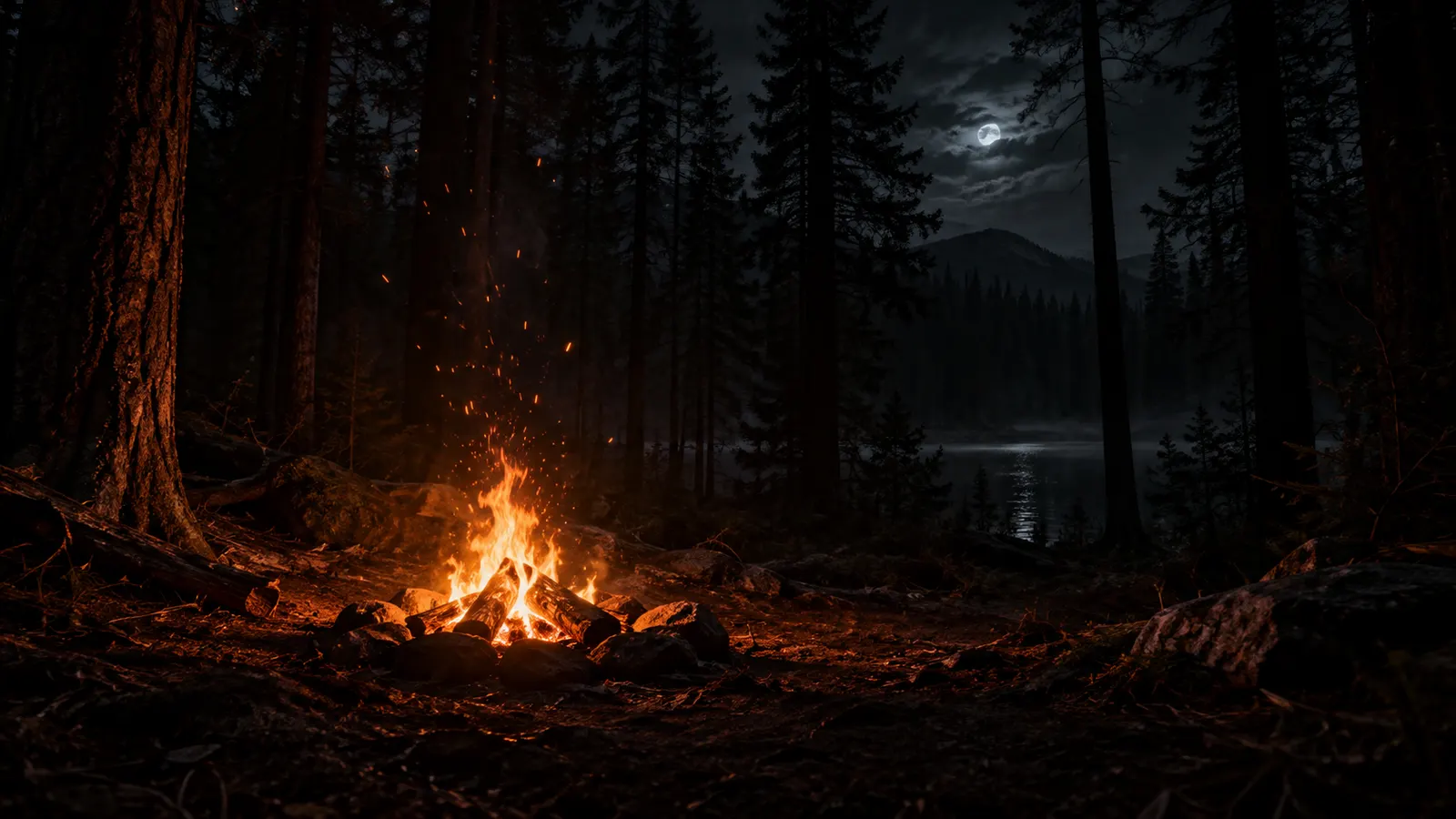
The October 11 campfire ballot closed with zero votes for all five tales. This continuation uses the announced first-tale editorial fallback; it was not selected by readers.
The Wrong Side of the Fire
By the time her father dragged the canoe onto the gravel, Dana had made herself stop looking at the cooler. The lantern beside it was out. That did not mean the person holding it had gone. She could still see the pale space where a hand had rested against the handle, like the patch left when you move a picture from a wall.
Her father laid the paddle down and rubbed his palms. “Nothing over there,” he said. “Wet stones. A beer can. We’re going to bed.” He sounded annoyed in the ordinary, comforting way he sounded when a cupboard door wouldn’t close. Dana wanted that to be enough. Then he noticed she had put herself between him and the tent.
“I saw somebody sitting here.” She pointed with the flashlight, keeping the beam low. He looked at the cooler. Its white lid had a dark oval on it, wet around the edge and dry in the middle, exactly the size of a person sitting down. They had emptied it before supper. He touched the mark. His fingertips came away smelling of lake mud.
From inside the tent, her little brother said, “Dad says I can get up now.” Her father had not spoken. Dana called back that he should stay in his sleeping bag. There was a pause, then the small irritated sigh her brother used when adults changed the rules. “The other Dad said it.”
Her father went to the zipper. Dana caught his wrist so hard he turned toward her. Across the lake a light came on, not the steady yellow lantern she had watched before, but a thin white glimmer. It flashed twice. Waited. Flashed three times. Her pattern. Someone had kept it.
“Give me the car keys,” she said. He started to argue, then the voice inside the tent spoke again, this time with his exact breathless laugh. “Don’t make a production of it, Dana.” Her father stopped moving. He put the keys in her hand without taking his eyes off the zipper.
What the Light Could Not Copy
The car stood beyond the fire ring, up a narrow track under the trees. Reaching it meant passing the cooler. Dana pressed the unlock button. Nothing blinked. She pressed again, closer to her chest, as if the keys needed shelter from the night. This time the headlights answered from the far shore.
Her father whispered, “That isn’t the car.” It was the first useful thing either of them had said. He picked up the paddle and laid it across the tent entrance. Then he knelt, keeping his hands outside, and asked her brother to push his feet against the fabric. Two heels made bumps near the bottom seam. A third bump rose beside them.
Dana put her flashlight on the ground facing the cooler. In that white strip the wet oval disappeared. When she lifted the beam away, it returned. The thing did not stand up or duck. It simply was not visible where their own light fell. Across the water, the glimmer swept left and right, showing her the same answer twice.
She had been using flashes as words. The person opposite was trying to show her a place. A strip of gravel. A way out. The first warning had never meant her father should paddle over alone. It had meant all of them should leave the campsite together.
“We go in the canoe,” she told him. “Now. No bags.” He looked at the narrow boat and the black water. Her brother was eight and could swim only where his feet touched. The life jackets were hanging on the low branch behind the cooler. Her father’s gaze went there. The lantern clicked on beneath them.
It lit nobody’s face. There was only a bent pair of sleeves, green like her father’s jacket, and two hands laid politely on the knees. Her father was wearing that jacket beside her. On the cooler, something lifted one hand and patted the empty space next to it.
Dana held the flashlight steady. “Get the jackets.” Her father moved through the beam. Where it touched the sleeves they flattened into empty cloth; where it slipped, a shoulder rounded under them again. Her wrist began to shake. He pulled down all three jackets and backed away, and the thing said in her brother’s voice, “You forgot me.” Her real brother began to cry inside the tent.
Three People in a Small Boat
They did not open the zipper. Her father used the knife from his pocket to cut the rear wall while Dana kept the beam across the cooler. Her brother crawled through in socks, dragging his sleeping bag. Something held the far end. His father cut that too. Feathers blew across the gravel, white and slow as moths.
There were three of them. Dana counted out loud as she fastened the jackets: one, two, three. Her brother asked whether the other Dad needed one. She said no. Not because she knew what it needed, but because she could not bear to hear her father answer in two places at once.
The canoe lay nose-up on the shore. Her father pushed it down until water filled the shallow dents under its ribs. He put her brother in the middle and told Dana to sit facing the campsite. He would paddle from the stern. “Keep the light on us,” he said. “Don’t try to see everything.”
The boat shifted under her. For a moment the beam went sideways. Something struck the hull, not hard, just a palm laid flat against it. When she brought the light back, a muddy handprint stayed on the aluminum. Five fingers. An extra thumb on the wrong side.
Her brother started counting with her. One, two, three. Her father pushed off. They moved backward from the camp, with the lantern getting smaller and the light on the far shore growing steadier. Dana could hear two paddles although her father had only one. One dipped behind her; the other made the same sound a fraction later beneath the canoe.
“Don’t match it,” she said. Her father took two quick strokes and rested. The sound under them took two quick strokes and did not rest. It continued ahead, as if it had finally been given permission to go somewhere. The canoe rocked once and settled. For the first time that night, the water sounded empty.
Halfway across, the flashlight dimmed. Dana slapped its side. Her father told her there were spare batteries in his bag at camp, and immediately apologized for saying it. The thin white light ahead swung toward a wooden post. Under it, something metal reflected. She could make out a square with a pale cross on its face.
The Rescue Box
They landed on the gravel strip her father had already searched. He swore the post had not been there. Dana believed him. She also believed the faded letters under the cross: EMERGENCY LIGHT. The box was bolted high enough that a child could not reach it. Below its door, a smaller plate read: FOR M. BELL, WHO KEPT THE SHORE.
The white glimmer came from inside the box. Her father opened it and lifted out an old hand-cranked lamp. Its handle was still turning, slowly, without a hand on it. He stopped it with his thumb. The light faded. When he turned the handle himself, it grew bright again. Dana switched off her dying flashlight.
Behind the lamp lay a folded sheet in a plastic sleeve. Most of the writing had blurred, but someone had traced four lines again in pencil. KEEP YOUR OWN LIGHT. COUNT YOUR OWN PEOPLE. FOLLOW THE NORTH PATH TO THE ROAD. LEAVE THE LAMP FACING THE WATER. Underneath, in a different hand: Nobody should have to signal alone.
There was a photograph tucked behind the sheet: a woman beside this same post, holding the lamp with both hands. A small boy stood on the gravel with a towel around his shoulders. Someone had torn away the bottom where a date might have been. Dana put the sheet and photograph in her jacket. She left the plastic sleeve in the box.
Her father wanted to carry the lamp. The path ahead was nearly invisible. Dana read the last line again. Across the water their tent lit up, as though somebody had switched on the sun inside it. Three shadows stood against the fabric. One tall, one medium, one small. The medium shadow raised an arm.
Taking the lamp would give them light for the walk. Leaving it would keep that shore in view. Dana understood the choice before she understood the rule. She had made her father cross once while she watched safely from camp. She would not carry away the only thing that had watched for them.
They took turns on the crank until the lamp held its brightness. Her brother counted the turns, fierce with concentration. Then her father hooked it to the open door, facing the water. They entered the north path together, touching shoulders, with Dana’s weak flashlight pointed at their feet. Nobody answered when the campsite began calling their names.
The Part They Brought Home
The path ended at a guardrail. Beyond it stood a mile marker and, farther down the road, a house with a porch light. They walked toward that ordinary bulb until a dog began barking. The woman who opened the door called the ranger and gave her brother dry socks. Dana sat on the kitchen floor because she no longer trusted her knees.
At dawn the ranger drove them back for the car. The cooler was dry. The tent was cut open on both sides. Their sleeping bags lay inside in three neat rolls, including the one her father had severed. He refused to touch any of it. He took the keys from Dana, started the car and kept his son beside him while she spoke to the ranger.
She asked about M. Bell. His expression changed at the initial, before she could show him the photograph. “Miriam,” he said. “She watched that strip before there was a ranger station. Saved a boy in a storm. Went back for whoever she thought she could still hear.” He stopped. Dana did not ask him to finish.
He knew the rescue box, though he said its lamp had been missing for years. When Dana gave him the four rules, he asked where she had found them. “Inside it.” He looked across the lake, then at the torn photograph. “There used to be a record of that night. Not just the accident report. Her own pages. I never found them.”
Dana kept the photograph. She let him copy the rules into his notebook, watching each word as if a spelling mistake could open a door. He closed the campsite for the day. That was something real. A barrier across the track. A sign. No family would arrive there that evening because a booking calendar told them it was safe.
At home her brother slept in the spare bed beside hers for two nights. Her father bought a battery lantern and put it on the kitchen shelf. They never agreed about what they had seen, but none of them said it had been a reflection again. The three of them had left Fallow Lake. All three had reached home.
On Monday the ranger called. He could keep the campsite closed while he inspected it, but not forever on a story alone. If Dana wanted, he would take her to the old keeper’s shed to look for Miriam’s missing pages. He asked her not to post the photograph yet. People came to places for the wrong reasons.
Dana laid the picture beside her phone. The woman in it was not looking at the rescued boy or the camera. She was looking toward the far shore, holding the lamp where someone else could see it. Dana could publish the warning and let people decide what to believe. Or she could go back with the ranger and search for the part that might make them listen. Outside her window, the streetlights came on one by one. This time, she counted only the people in the room.
What should Dana do with the warning she brought home?
Voting has closed. These options belong to the original edition; see the revision note below.
Closed Sunday, October 18 at 7:00 PM ET · One vote per browser
Loading the recorded result… The ballot records votes, not the publication status of a revision.
Published by LiveLore · AI-assisted fiction
Join the story-update list below. Email dispatches have no confirmed schedule; you can remove your address using your private unsubscribe link.
← Back to the stories