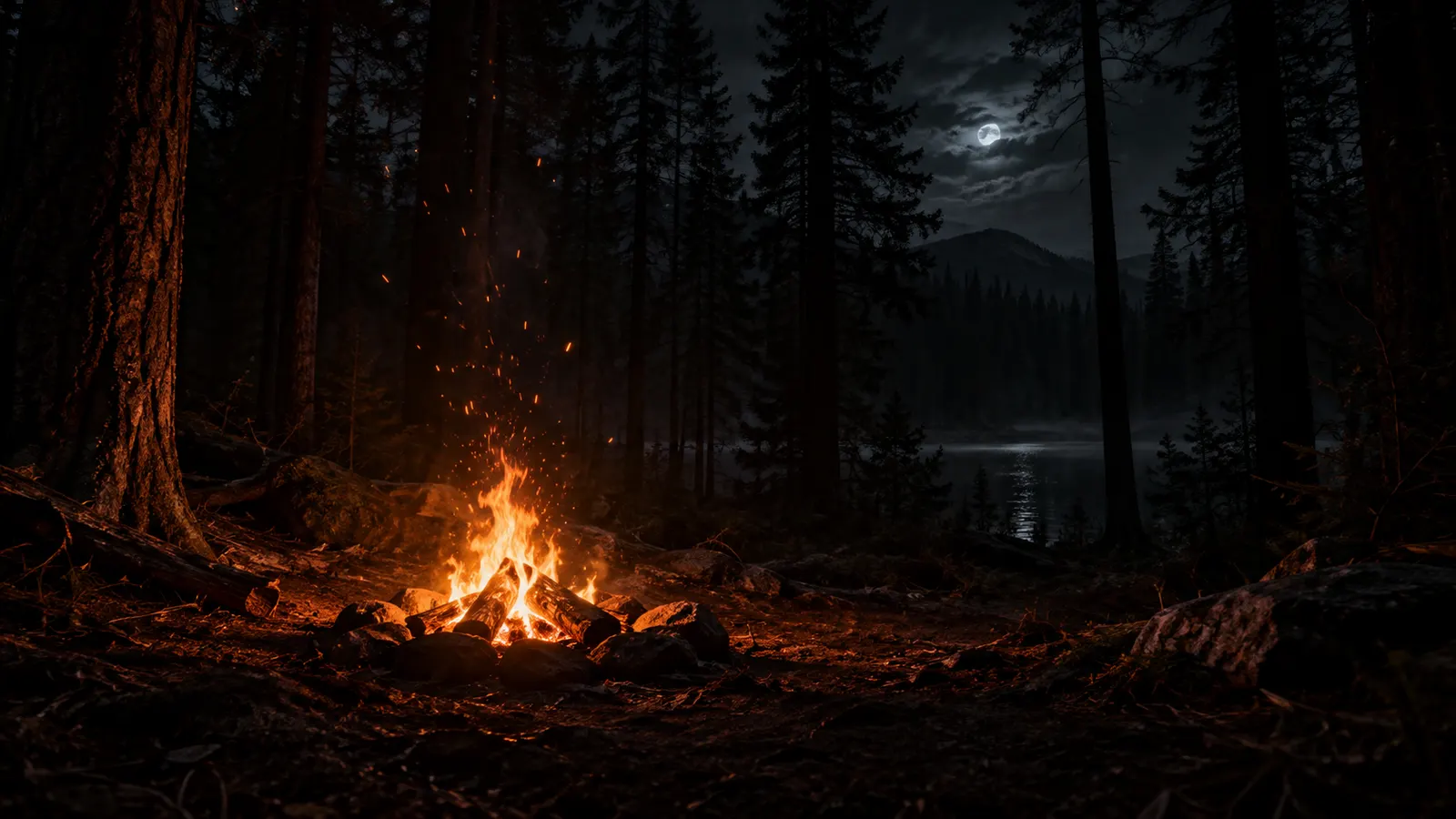
These campfire scary stories are short enough to tell from memory and strange enough to follow everyone back to the tent. Each one takes three or four minutes to read aloud. They are written for teens and adults: no gore, just endings with a twist. Read them here first, then tell them in your own words when the fire burns low.
Picking Campfire Scary Stories for Your Group
The best campfire scary stories are rarely the goriest ones. They are the ones that make everyone glance at the treeline the next time a log pops. All five tales below are built for that moment. Each starts somewhere ordinary, like a quiet lake, a tent zipper, a scenic overlook, a roadside firewood stand or the circle you are sitting in right now, and then breaks one small rule.
Telling scary campfire stories for adults? Read them as written and let the endings land. “Firewood for Sale” and “Don’t Unzip the Tent” leave the darkest aftertaste. Telling scary campfire stories for kids? Keep the setups and soften the last beat; the notes near the end of this page show where to stop each tale. For a mixed group, “The Echo That Answered First” works well, because the scare is a sound rather than a sight.
These are short stories to tell in the dark, so there is nothing to memorize. Read one through twice, hold on to three beats (the place, the rule, the moment the rule breaks) and tell it in your own voice. Keep “The Last One Awake” for the very end of the night, when the fire is mostly coals.
1. The Lantern Across the Lake
My cousin Dana swears this happened at Fallow Lake, the summer she turned sixteen. The lake is small enough to shout across. On the far shore there are no campsites, only birch trees and a strip of gravel where people sometimes beach their canoes. That night, around eleven, a lantern lit up over there.
Dana was the only one still awake. She picked up her flashlight and, mostly as a joke, flicked it on and off twice. Across the water, the lantern dimmed and brightened. Twice. She tried three flashes. Three came back. She tried one long flash and two short ones. The lantern copied that too, perfectly, the way a mirror copies you.
It was fun for about a minute. Then the lantern started sending something she had not sent. Three short. Three long. Three short. Dana had been a Girl Scout. She knew what it meant before she finished counting. S-O-S.
She woke her dad. He watched the far shore with his arms folded, then pulled on his boots and dragged the canoe to the water. Dana kept her flashlight on the lantern so he could steer. Halfway across, the lantern went dark. Her dad stopped paddling and called hello. Nobody answered. The lake was so still she could hear the drips falling from his paddle.
He paddled the rest of the way, walked the gravel strip with his own light, and found nothing. No tent, no canoe, no footprints except his. When he got back, he said it was probably a reflection, a car on the road behind the trees. There is no road behind those trees. Dana checked the map the next morning.
Here is the part she leaves out unless you ask. Before her dad pushed off, she looked back at their own camp, just once, to make sure her little brother was still asleep. Beside the tent she saw a second lantern, held low, at the height of someone sitting on the cooler. It went dark the instant she looked at it.
Dana says she understands it now. The far shore was never copying her flashlight. It was signaling past her, to whatever was sitting in her camp. And when that didn’t work, it tried to warn the only person still awake. Three short. Three long. Three short. Get in the canoe. Don’t look behind you.
2. Don’t Unzip the Tent
Every tent zipper makes the same sound. That is the first thing to know about this story. Zzzzip, up and around. You hear it a hundred times on a camping trip and stop noticing it, which is exactly the problem.
Marcus and his older brother Theo were sharing a two-person tent at a state park in Ohio. Their parents had the big tent ten feet away. Around two in the morning, Marcus woke to the sound of a zipper. Slow. Somebody being careful. He assumed it was Theo going out to pee.
But Theo was asleep beside him. Marcus could feel his brother’s back against his arm, rising and falling.
The zipper stopped halfway. Marcus stared at the door of their tent. It was closed. The pull tab hung at the bottom, exactly where they had left it. Then the sound came again, and he realized it was not their tent at all. It was coming from the big tent. His parents’ tent.
He heard the zipper finish its long curve. A pause. The flap brushing nylon as somebody stepped through. Footsteps crossed the pine needles between the tents and stopped right outside his door.
“Marcus,” a voice whispered. “Are you awake? Unzip the tent.” It was his mom’s voice. Calm. Too calm, the way she sounded on the phone with strangers.
Marcus almost did it. His fingers were on the tab. Then Theo, who he had thought was asleep, closed a hand around Marcus’s wrist and held it there. Theo didn’t move or open his eyes. He just held on until the footsteps went away, and the zipper on the big tent sounded one more time, slow and careful, closing.
In the morning their parents swore they hadn’t left their tent all night. Their dad always locked the two zipper pulls together with a tiny padlock because of raccoons. The lock was still closed. Marcus asked Theo how he had known not to open the door.
Theo looked at him for a long time. “Because it came to our tent first,” he said. “Before you woke up. It used Mom’s voice, and it said my name.” He wouldn’t look at the door. “I already unzipped.”
3. The Echo That Answered First
Ridgeline Overlook is famous for its echo. Stand at the rail, shout across the valley, and the cliffs throw your voice back three times, each one smaller than the last. Families stop there on the drive up to the campground. Kids love it.
We stopped there at dusk, five of us, on the last night of a scout trip. Our leader, Mr. Halvorsen, let us take turns. You shouted your own name and counted the echoes. “Danny!” Danny. Danny. Danny. “Priya!” Priya. Priya. Priya. Everybody laughed. It was the best part of the trip.
Then it was my turn. I filled my lungs and opened my mouth, and before I made a sound, the valley said my name. Jesse. Jesse. Jesse.
Nobody laughed. Mr. Halvorsen said somebody on the trail below was playing a joke, and he told us to get back in the van. On the drive to camp he kept the radio loud.
That night by the fire he told us the old story about the overlook. People used to say the cliffs keep a list. When you shout your name, they aren’t echoing you. They’re checking you off. Most people hear their name three times. Once, the story goes, a hiker heard it four times. He was gone by morning. Mr. Halvorsen said it like a joke. He was looking at me.
I didn’t sleep. Around three I opened the tent flap for some air, and I heard it, faint, from miles away across the dark: names. One after another, in a calm voice, like someone reading a list. Danny. Priya. Owen. Mr. Halvorsen. Every person in our group, in the order we had shouted. Each name echoed three times and then went quiet.
Then it said my name. I counted. Jesse. Jesse. Jesse.
And then, very softly, right outside the tent, a fourth time.
4. Firewood for Sale
Most campgrounds tell you not to bring firewood from home, because bugs travel in it. So you buy it from whoever sells it nearby: the camp store, a farm stand, a cooler of bundles with an honor box. This story is about the honor box on County Road 12.
It’s a wooden crate at the end of a gravel drive with a hand-painted sign: FIREWOOD $5. LEAVE WHAT’S FAIR. The bundles are neat, tied with twine, the bark still on. People say it’s the best wood in the county. It catches on one match and burns for hours without smoke.
My friend Laila stopped there on the way to Copper Creek. The box was stuffed with five-dollar bills. She didn’t have cash. She took a bundle anyway and told herself she would pay on the way home.
That night the fire was perfect. Hot, bright, almost no smoke. Then it began to make sounds. Small pops at first, like any wood. Then something like a sigh. Then, in the long hiss of sap boiling out of a log, Laila heard her name. Not loud. The way someone says it from the next room.
She told herself it was the sap. She put on another log. The sigh came again, and this time every flame leaned toward her, the way grass leans in the wind, though there wasn’t any wind.
At dawn she drove straight back to County Road 12 with a twenty-dollar bill in her hand. The crate was there. The sign was there. But the drive behind it was overgrown, and the farmhouse at the end had no roof. Burned, a neighbor told her later. Years ago. The old man who lived there used to sell firewood, and he never forgave anyone who didn’t pay.
Laila pushed the twenty into the box. Then she noticed the bundles. Under every knot of twine was a small paper tag she hadn’t seen the day before, each with a name written in pencil. There was only one bundle left in the crate. She didn’t have to turn the tag over to know whose name was on it.
5. The Last One Awake
This is the shortest story, and you tell it last, when the fire is mostly coals and everyone is pretending they aren’t tired.
There was once a group of friends camping in the woods, just like us. They told stories until late. One by one, they fell asleep around the fire. And every time one of them closed their eyes, something in the trees moved one step closer.
It never touched the ones who were asleep. Sleepers are boring. It was waiting for the last one awake: the one who sits alone by the coals, listening to everyone else breathe, telling themselves it’s only the wind.
The last one awake always hears it first. A twig snapping just behind them. Then slow breathing that doesn’t belong to any of their friends. Then a hand, cold as creek water, settling very gently on their shoulder.
Teller’s note: pause here. Look slowly around the circle. Lower your voice almost to a whisper and ask, “So. Who’s going to be the last one awake tonight?” If a friend is sitting behind the group, this is when they rest a cold hand on someone’s shoulder.
How to Tell These Campfire Scary Stories
Don’t memorize them word for word. Learn the shape of each one: the setup, the rule, and the moment the rule breaks. Then tell it as if it happened to someone you know. “My cousin swears this is true” beats “once upon a time” every time.
Slow down before the twist. The pause is the scariest part of any campfire story. Let the fire pop. Let someone ask, “And then what?” before you answer.
Know your audience. These scary campfire stories are written for teens and adults. For younger campers, end “The Echo That Answered First” after the third echo, and end “Don’t Unzip the Tent” when Theo grabs his brother’s wrist. The setup is spooky enough on its own.
Save “The Last One Awake” for the end of the night. It works best when everyone is already yawning.
Which campfire story do you want continued?
Voting has closed. These options belong to the original edition; see the revision note below.
Closed Sunday, October 11 at 7:00 PM ET · One vote per browser
Loading the recorded result… The ballot records votes, not the publication status of a revision.
Campfire Scary Stories FAQ
Are these campfire scary stories okay for kids?
They are written for teens and adults, with no gore. For younger campers, shorten the endings: stop “The Echo That Answered First” after the third echo, stop “Don’t Unzip the Tent” when Theo grabs his brother’s wrist, and end “The Lantern Across the Lake” with the SOS signal from the far shore. For the closing story, skip the cold hand on the shoulder and simply ask who will stay up last.
Which campfire stories work for 12 year olds?
Most 12-year-olds can take the full versions of “The Echo That Answered First” and “The Lantern Across the Lake”, because the scare in each is a sound or a signal rather than anything seen up close. Save “Firewood for Sale” and “Don’t Unzip the Tent” for older teens, or use the shorter stopping points above.
Do all five campfire stories have a twist?
Yes. Each one sets up a simple rule early, then breaks it in the last few lines, so the twist lands best if nobody has heard the story before. If someone guesses the ending, move on to the next tale rather than stretching it out.
Which story works best for an adult crowd?
“Firewood for Sale” and “Don’t Unzip the Tent” have the bleakest endings, because both close on a line suggesting the worst is already in motion. Tell them late, after the lighter stories, and do not rush the final line.
How do you tell a scary story in the dark?
Let the fire burn low and keep a single light, or none. Speak more slowly than feels natural, and go quiet right before the twist instead of getting louder. Telling a story as something that happened to a cousin or a friend makes it feel closer than a story that begins with “once upon a time”.
How long does each story take to tell?
Each one takes about three to four minutes to read aloud. The fifth story is the shortest and is meant to close the night.
Are these campfire stories true?
No. They are original fiction written for LiveLore with AI assistance and human review. The “my cousin swears this happened” framing is a storytelling device, and it is a good one to borrow when you retell them.
Published by LiveLore · AI-assisted fiction · human-reviewed
Join the story-update list below. Email dispatches have no confirmed schedule; you can remove your address using your private unsubscribe link.
← Back to the stories