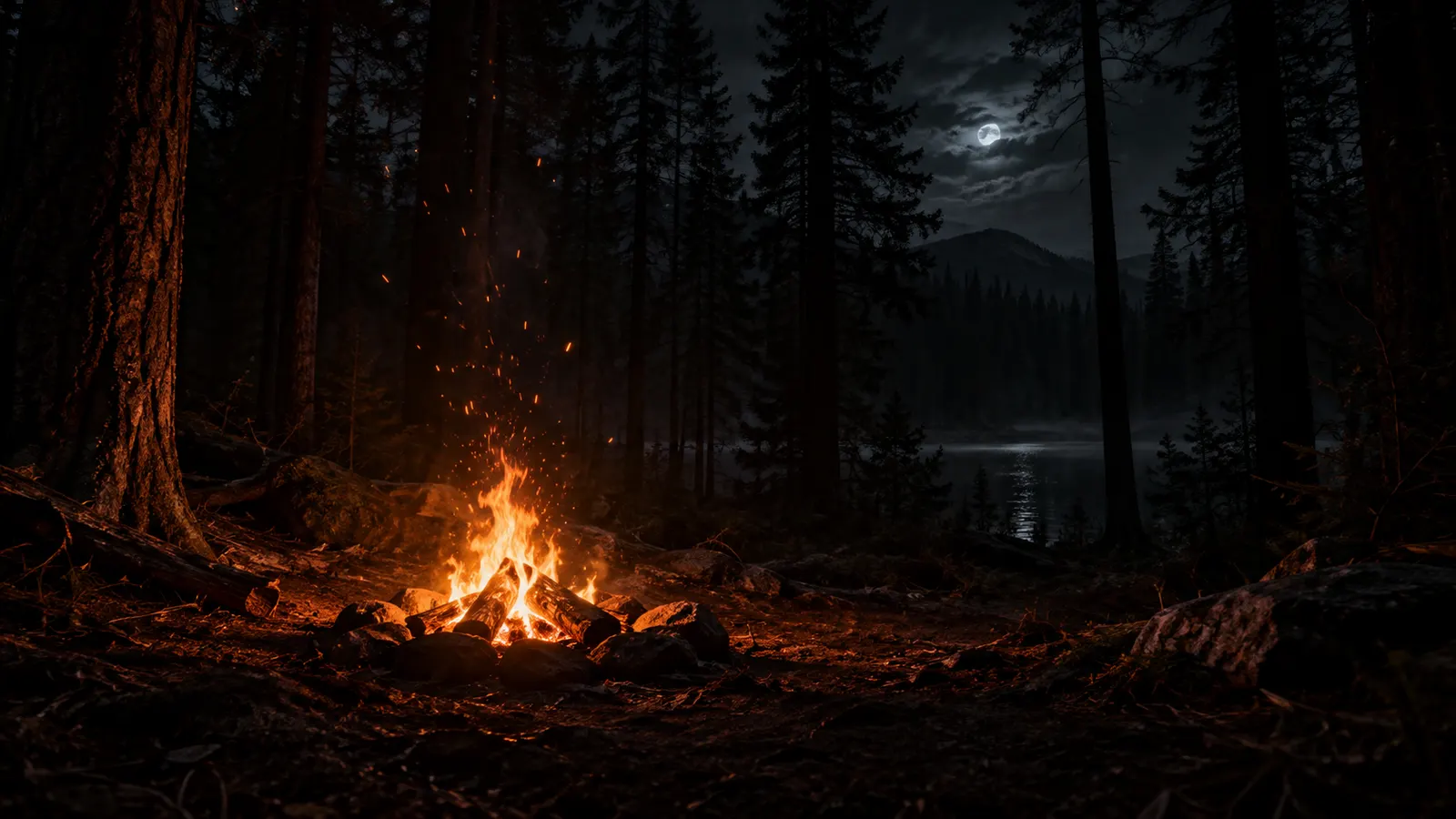
Chapter Four follows readers’ lead from Chapter Three: Dana goes back to the shore at sunset to keep a light burning.
Building a Light
They chose the shore. The county board would meet on Thursday no matter what they did, Hale said, and he would take copies of the pages there himself. But closing the lake would not bring back the lamp, and the last weekend was in three days. If the thing on the water was waiting for a count to come out wrong, then the only honest answer was to give it a count that came out right.
Dana’s father spent Thursday evening in the garage. He had never been handy, but he was stubborn, which Dana decided was almost the same thing. By midnight he had built a lamp out of a camping lantern, a bicycle dynamo and a crank from an old pencil sharpener. It whined when you turned it. It cast a hard white circle on the ceiling. “It’s ugly,” he said, sounding proud.
Hale brought something too: the keeper’s logbook. Not Miriam’s pages, but the official one, the county’s, which he had pulled from the archive that morning. It had a column for the date, a column for the weather and a column marked *Count*. Every entry had two numbers. Out, and back. The last entry in Miriam’s hand was the night of the storm. One out. One back. Then a different hand had added a third number, and crossed it through.
Dana’s brother wanted to come. Nobody agreed to that. He sat at the top of the stairs while they talked and listened anyway, and when Dana went up to bed he was waiting in the doorway of her room. “If it calls in my voice,” he said, “I’ll be here. In bed. So it’s not me.” She told him that was exactly right, and that was the most important job of all, and she meant it.
The Keeper's Hour
Friday at sunset the lake was the color of old pewter. They parked by the boat launch: Dana, her father and Hale. Three people. Dana wrote the number on the back of her hand in marker, the way Miriam might have written it in the log. Her father did the same. Hale, after a moment, held out his hand for the pen.
The shed door stood open. Inside, the empty hooks all faced the window. Hale hung their ugly lamp on the middle one, and Dana began to turn the crank. The whine filled the little room. The light grew, white and steady, and fell through the dirty glass onto the water in a long pale path.
For a while nothing happened. A loon called somewhere south. Her father texted her brother, who replied with a photo of himself in bed with the covers pulled to his chin. Dana kept winding. Her arm began to ache. She switched hands. Out on the water, along the edge of the light, the surface began to ripple, as if something very large were turning over without quite breaking through.
Then the voices started. Not loud. Conversational, from the dark beyond the window, the way people talk on a porch at night. Her mother’s voice, though her mother lived two states away and had not called in months. Her brother’s voice asking for water. Hale’s voice, but younger, much younger, saying he was cold and couldn’t find the boat. Hale went very still.
“Count,” Dana said. Her own voice sounded thin to her. Her father said, “One.” She said, “Two.” Hale did not answer. The young voice outside said, “Three,” in a small shivering way, and then it laughed.
One Out, One Back
Dana stopped winding. She did not mean to. Her hand simply opened. The light dipped at once, the white path on the water fading to gray, and in the gray she saw it at last, standing just past the reach of the beam. It was the shape of a boy in a towel. It was the shape of a woman holding a lamp. It was both, and it was neither, and it was looking at Hale.
Her father grabbed the crank and turned it so hard the lantern rattled on its hook. The light came back. The shape was gone. Hale was standing in the doorway now, half out of the shed, one foot on the wet step. He was not looking at the water anymore. He was looking at the far shore, where for one second a yellow light had flickered and gone out.
“She’s still out there,” he said. “She went back for me. Twice. Nobody went back for her.” Dana understood then what the crossed-out number in the log meant. Someone had counted Miriam as coming home. Someone had been wrong, or had wanted so badly to be right that they wrote it anyway.
Dana took Hale’s hand, the one with the number three on the back of it. She did not pull. She just held it up into the light so he could see it. “Count your own people,” she said. “That’s the rule. She wrote it for you.” He looked at the number for a long moment. Then he stepped back into the shed. “Three,” he said, in his own voice, the tired gray one.
Outside, the young voice stopped laughing. Then all the voices stopped at once, like a radio pulled from the wall.
The Lamp Across the Lake
They wound the lamp in shifts until full dark. Then, because the rules said so, they did not take it away. Hale wrote the date in the keeper’s log, then the weather. In the column marked *Count* he wrote *3 out, 3 back*, and he did not let himself write anything else. Dana watched him do it and thought it was the bravest thing she had seen all week.
They were walking to the truck, flashlights on, when the far shore lit up. Not the white glimmer of the rescue box lamp. A steady yellow light, low on the gravel strip, the kind you carry in two hands. It did not flash in Dana’s pattern or any other. It simply stayed, facing the water, facing them, the way a porch light stays on for someone who is late.
Hale stood by the truck for a long time. Dana’s father did not hurry him. Eventually Hale lifted his own flashlight and switched it off and on once. Across the lake, the yellow light dipped, the way a lamp dips when someone lowers it to set it down. Then it held. It was still burning when they reached the road.
At home, her brother was asleep with the covers over his head. Her father counted him twice, standing in the doorway, and then once more, and then went to bed. Dana stayed up and copied Miriam’s last page into her own notebook, adding a line underneath in her own hand: *3 out, 3 back. Someone answered.*
Who Keeps the Shore
On Saturday the county board voted to close the campground early, citing shoreline maintenance. Hale did not show them Miriam’s pages. He showed them the accident reports, which was enough. The last weekend was canceled. The barrier went back across the campsite track, and this time it was chained.
But a closed campground is not an empty lake. Hale said so on Sunday, sitting at Dana’s kitchen table with the keeper’s log open between them. The shed would still be there. The lamp would still need winding. Someone would still walk the shoreline in winter, hunters and kids and people who did not read signs. The rule had never been *keep everyone away*. It had been *nobody should have to signal alone*.
He could take the job himself. He was the ranger. He knew the shore and the shed and, now, the count. But he was sixty-one, and he had kept that lake for twenty years without knowing what it was, and he was tired. Or the job could be shared. A rota of names in the back of the log. Dana’s family, the woman with the porch light by the road, anyone who had ever come home from the water because a stranger kept a light on.
Dana looked at the photograph, both halves taped together now on her bedroom wall. Miriam was holding the lamp with both hands, looking toward the far shore. For the first time, Dana noticed that the boy beside her was looking the same way. Outside, the streetlights came on one by one. She counted the people in the house, and then, because it felt right, she counted one more, out across the dark water, still keeping her light.
YOUR TURN · NO SIGN-IN NEEDED
Who should keep the lamp at Fallow Lake now?
Each Wednesday the next chapter follows readers’ leading choice; when the vote is close, the editors decide using readers’ choices and ratings.
- 1. Choose what happens next
- 2. Rate this chapter
Published by LiveLore · AI-assisted fiction
Join the story-update list below. Email dispatches have no confirmed schedule; you can remove your address using your private unsubscribe link.
← Back to the stories