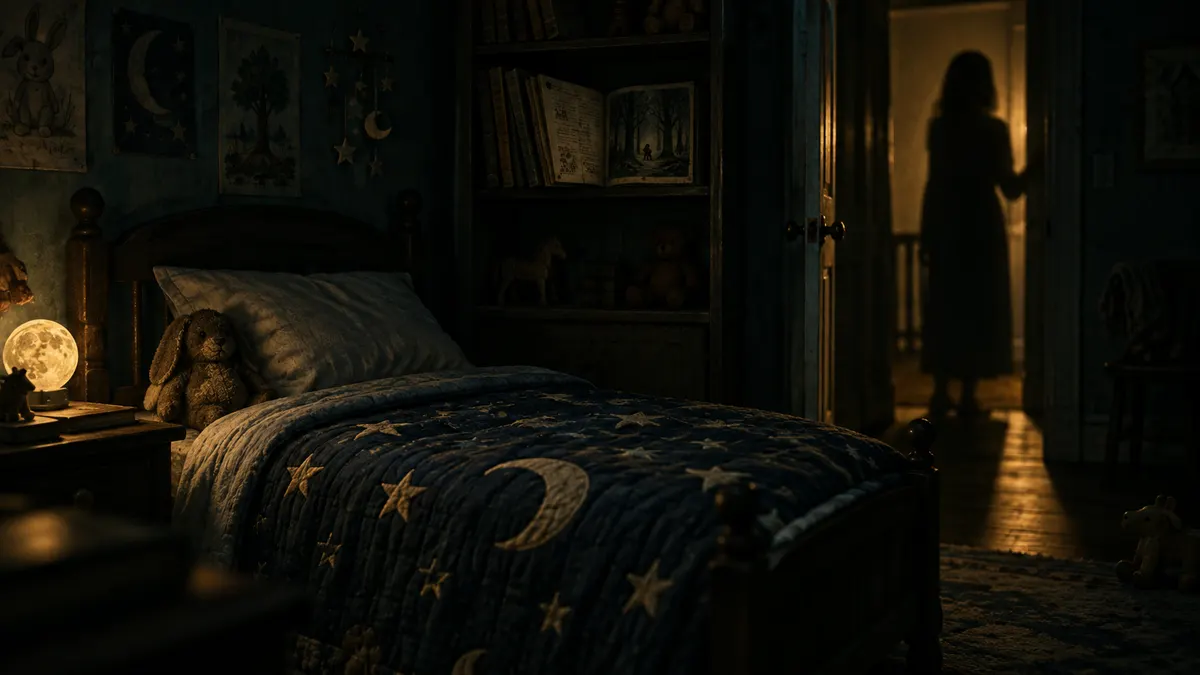
Mia was eight when she learned that the dead don’t always leave. Every night at 9:00 the door cracked open, familiar footsteps crossed the carpet, and the blanket was pulled up to her chin. A kiss. A whisper: "Go to sleep, sweetheart." Mia never told anyone — because she was afraid of what would happen if the tucking ever stopped.
The small familiar things
Her father thought she slept through the night now. He told the school counselor this in the kitchen, speaking softly while Mia colored at the table. “Much better,” he said. “The routine helps.” The counselor smiled at her. Mia smiled back, because the routine did help. It mattered that the door opened exactly wide enough to let a strip of hallway light fall across the rug. It mattered that the footsteps paused beside the bookcase.
Mom had always straightened one book before coming to the bed. Mia never understood why. Even on evenings when they had argued about homework, even when Mom was too tired to read, she pushed that book flush with the others. Then came the blanket, the kiss, the words. After the funeral, Mia waited through nine empty nights before the footsteps returned. She had cried with relief into her pillow.
She knew it was not a dream because dreams did not tuck in the left corner first. Dreams forgot details. This visitor remembered the rabbit under Mia’s elbow and left the door open afterward. Mia lay with her eyes shut and let each small familiar thing happen in its proper order.
In the morning, the blanket was always tight around her feet. Her father blamed the washing machine for shrinking it. He bought a larger one with yellow moons on it. That night, the visitor folded the extra length beneath the mattress. Mia felt the weight of both hands resting near her ankles for a long time. Then the usual kiss came, and she allowed herself to breathe normally.
The problem began with the smell. Mom had used orange shampoo, sweet and sharp like the peel Dad put into the kitchen bin. For months the pillow smelled faintly of it after the visit. One night the sweetness was gone. Something dusty remained, like a cupboard nobody had opened since winter. Mia kept her eyes closed and counted the steps back to the door. There was one too many.
A question after breakfast
She asked her father whether people could forget how they used to smell. He was buttering toast and did not look up. “Memory changes a little,” he said. “That doesn’t mean we’re losing her.” Mia wanted to explain that she was not talking about memory, but he looked so tired that she let him finish. He wrapped the toast in a napkin because they were late again. Before leaving, he checked his phone against Mia’s bedroom clock and muttered about replacing its battery; it was fifteen minutes slow.
At school, she drew her bedroom during free time. Four walls, a window, the bed, the bookshelf. Beneath the bed she drew a narrow black rectangle. The teacher asked whether it was a box of toys. Mia said yes. She did not know why she had drawn it. She shaded it until it looked like the narrow gap she watched every night, waiting for something to move.
That evening, Dad found the picture in her bag. He asked if something was frightening her at night. The question came so close to what she wanted that she nearly said yes. Then a board creaked upstairs. It was only eight thirty. Dad looked toward the ceiling, and Mia saw a hope cross his face before he could hide it. She understood that he listened for footsteps too.
“Just the radiator,” she said. He nodded too quickly. They ate dinner in front of a nature program and laughed at a bird that kept stealing another bird’s nest material. It was a good evening. Mia wanted to keep it good. At eight fifty-five she went upstairs without being reminded, put the picture facedown on her desk, and waited for the bedroom door to open.
The visitor came on time. Left corner first. Rabbit safe beneath the elbow. A kiss that touched her forehead but did not warm it. “Go to sleep, sweetheart.” Mia held still. The visitor remained beside the bed. After a while, it said the words again, in exactly the same voice, at exactly the same speed. Something under the mattress answered with a long, disappointed sigh.
The book pushed straight
On Saturday, Mia looked beneath the bed in daylight. There was a sock, a marble, and the flat cardboard box that had held her new blanket. Nothing else. She pulled everything out, even the dust, and asked her father to help move the bed against the other wall. He agreed, pleased to have a job with a clear beginning and end. They spent the afternoon rearranging her room.
At nine, the footsteps crossed to the old position of the bed. They stopped there. Mia lay against the opposite wall and waited. She heard the book slide into place. Then footsteps returned to the doorway and began again. This time they found her. The blanket rose very slowly, as if lifted by hands that were uncertain where her body ended. She tucked her feet close and did not speak.
In the morning, she pulled the straightened book from the shelf. It was an old collection of fairy tales, the cover worn smooth at the corners. Mom had read from it when Mia was little. Between two pages lay a photograph of a girl in a bed that looked exactly like hers. On the back, Mom had written: Don’t let the woman under the bed remember where you sleep. Beneath that, in faded childhood pencil, was a name: Agnes. The same name was printed beneath the shawled woman in the book.
The girl was Mom. Mia recognized the serious eyebrows and the small scar beside her mouth. She carried the photograph to Dad, who stared at the handwriting for a long time. He said Mom had grown up in this house with her grandmother, and that she had never liked talking about bedtime. “She said her grandmother was strict,” he added. “We all thought that was what she meant.”
Mia turned to the page where the photograph had been. The story was about a woman who gathered lost children beneath her shawl. Someone had crossed out the ending. In its place, in a child’s pencil, were instructions: Keep the book straight. Keep the blanket tucked. Don’t look at her face. At the bottom, written much later in Mom’s adult handwriting, was a longer note. I can keep Agnes outside the tucked blanket if you stay inside. Straighten her book to send her back to its story; she searches again whenever it opens. If you name her and tear out her page, the way closes to everyone who has come through it. Even me.
Nine nights without her
Dad wanted to leave immediately. He packed a suitcase while Mia sat on the stairs holding the book. For the first time, she told him about the visits. He did not say they were dreams. He asked what happened during the nine nights after the funeral, before the footsteps returned. Mia tried to remember. She had cried, certainly. She had called for Mom. There had been a noise beneath the bed.
She remembered it now: not scratching, but a fingernail running along the seam of the mattress, searching for a place where the blanket had come loose. On the ninth night she had woken with one foot outside the covers. Something cold held her ankle. Then familiar footsteps crossed the rug. The cold released her. The left corner tightened. Mom kissed her forehead, and the sound under the bed went still.
Dad put down the suitcase. They had been treating the footsteps as the danger because the person making them should have been gone. What if they were the only thing holding another visitor back? He looked up toward Mia’s open door. From the bedroom came the small wooden sound of a book being pushed straight. It was only four in the afternoon.
They drove to her aunt’s apartment anyway. Mia ate pizza at the kitchen counter and pretended not to hear the adults talking. Her aunt made a bed on the couch with a green blanket and a pillow that smelled of clean laundry. Dad sat in a chair nearby. At eight fifty-nine, a rectangle of light appeared on the floor beside the couch. There was no door to cast it.
A footstep sounded inside the wall. Dad stood so quickly that his chair struck the window. Mia pulled the blanket to her chin. It was too short to cover both shoulders and feet. Something beneath the couch sighed. She looked at Dad, and for the first time since the funeral he seemed younger than she was. “Take me home,” she said. The book in his hand opened by itself.
The name under the ending
Back in her room, they put the bed where it had always been. Dad promised to sit outside the door. He wanted to stay beside her, but every time he crossed the threshold, the blanket slipped an inch down the mattress. Mia asked him to stop. The clock read eight fifty-seven. Dad checked his phone: nine twelve. The old clock had lost fifteen minutes, as it had all week. There was no extra time. Whatever had followed the open book to the couch was already here.
Dad held the book against the hallway lamp. Beneath the crossed-out ending, Mom had copied Agnes again and again. This was the name on the photograph, not a word they had to guess. Beside it she had drawn a little door with a line through it. Dad read the warning about tearing out the page twice, then looked toward the place where Mom always stood.
The door eased toward its usual opening. Dad was still on the other side, one hand braced against the frame. Mia heard the first footstep, then the second. At the bookcase, the visitor paused. The book was not there. For the first time in a year, the familiar routine stopped before the blanket moved. The silence that followed felt crowded with something trying very hard to remember.
“Sweetheart,” said the voice. It came from beside her pillow and from beneath the bed at once. One hand caught the left corner of the blanket. Another caught the right. Mia could see her father’s shoes through the strip of hallway light. She could hear him beginning to say the name from the page. The slow clock had not yet reached nine. Mia knew better than to wait for it. She asked him for the book.
The untucked corner
Dad slid the book across the carpet, stopping it beside the bed. The right-hand grip dragged the blanket toward the floor. The left hand tightened the corner beneath Mia’s heel, exactly as it had on the night something caught her ankle. “Mom,” Mia said. The left thumb stroked her foot twice. When she had been small, that had meant yes without waking her. The other hand began copying the gesture a beat too late.
Mia could put the book back. She could keep the corners tucked and have the kiss again tomorrow. Mia did not know why Mom had left the page intact while she was alive. But now the warning was in her own handwriting, and the door Mia would close was the one Mom used to come home. Dad was crying in the hallway. “You don’t have to keep doing this,” he said, and Mia did not know which of them he meant.
Keeping her feet beneath the blanket, Mia reached down for the book. The right corner slipped. Cold touched one toe. She found the picture of the shawled woman and said the printed name aloud: “Agnes.” The cold stopped moving. The right hand flattened against the sheet, long fingers pressing so hard she could see each joint through the cloth. Mia gripped the page at its spine and pulled.
Paper tore with the sound of a deep breath drawn through teeth. The right hand vanished. Under the bed, something knocked once against the floor and then seemed to fall a very long way. The left hand remained long enough to tuck in the loosened corner. A smell of orange peel reached Mia. She kept her eyes shut for the kiss. It did not come.
Dad crossed the threshold. This time the blanket stayed where it was. He knelt beside her, took the torn page and folded it with the picture facing inward. They stayed awake together until the room became an ordinary room with a sock under the bed. That evening they took the book to her aunt’s, its empty binding closed. Nothing sighed beneath the couch. Dad found a blanket long enough to cover her feet.
At nine Mia listened. There were no footsteps, not even the extra one. She had saved the part of herself that could grow up; she had given up the part of each night in which her mother still came home. Dad asked whether she wanted the door open. “A little,” she said. He left a strip of light across the floor and went downstairs. Mia tucked the left corner in herself.
YOUR TURN · NO SIGN-IN NEEDED
What should happen next?
Each Wednesday the next chapter follows readers’ leading choice; when the vote is close, the editors decide using readers’ choices and ratings.
- 1. Choose what happens next
She Tucks You In FAQ
Is She Tucks You In one of your scary bedtime stories for children?
No. It is one of our scary bedtime stories for adults. It involves bereavement and a child in danger, so it is not a soothing bedtime story for kids.
What is She Tucks You In about?
Every night at 9:00, Mia’s dead mother returns to tuck her in. Her protection keeps Mia safe, but staying safe means choosing what to lose. This page is Chapter One of an ongoing horror story.
Where can I find more scary bedtime stories for adults?
Try our scary stories for adults, the Noctur horror story series, and our sleepover scary stories if you want something to read aloud.
Published by LiveLore · AI-assisted fiction · human-reviewed
Join the story-update list below. Email dispatches have no confirmed schedule; you can remove your address using your private unsubscribe link.
← Back to the stories