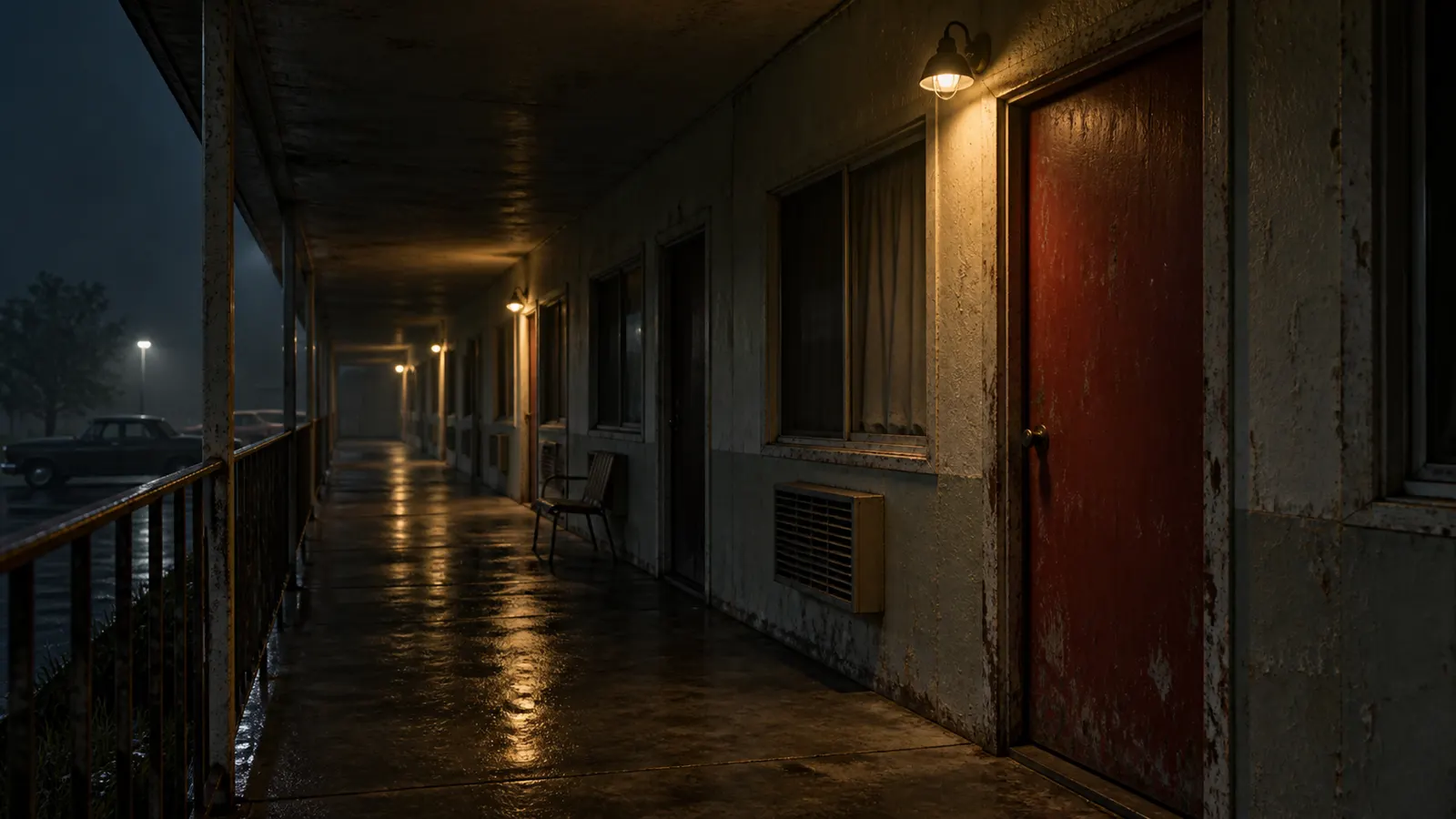
The night shift
When he hired me, the owner of the Holloway Motor Lodge asked whether I was a light sleeper. I said I was, thinking he meant the job would be quiet enough for naps. He smiled without showing his teeth. “That’s helpful,” he said. “If the phone rings, answer it before the fourth ring. People get confused if they have to wait.” He paid for my first week in cash.
I was twenty-six, newly divorced, and living in a car that had developed a sweet smell every time I turned on the heater. A job with a room was not an offer I could examine too closely. The lodge stood at the junction of two county roads. One led to a quarry. The other ended at a bridge that had been closed since the flood. No one explained why the motel had three floors.
My room was behind reception, separated from the desk by a thin wall and a curtain patterned with brown reeds. There was a bed, a hot plate, and a small window painted shut. Above the bed hung a landscape print of the lodge in daylight. In the picture, every window was open. In the building itself, every upper window had been boarded from the inside.
The owner showed me the switchboard, an old cream-colored machine with a row of buttons marked in fading ink. “Power goes out sometimes,” he said. “This has its own line.” He demonstrated the transfer button with two short taps. I asked why we needed a switchboard when there were only two guests. “People still call,” he said. Then he took his coat and left before I could ask who.
For the first four hours, nothing happened. A truck passed. The soda machine hummed. The guest in 104 came down for a towel, apologized for the trouble, and went back upstairs even though his room was on the ground floor. At eleven, I opened a packet of crackers. At eleven fifteen, a little amber light appeared beside the number 309. The telephone rang.
I answered on the second ring. A woman whispered, “Could you send someone up?” Behind her voice was another sound, soft and repetitive, like a person folding a sheet. I asked what she needed. “I’m having trouble sleeping,” she said. “The man in the next room keeps waking up.” I checked the guest ledger. Room 309 was not listed. Neither was 308.
A room off the books
The ledger had entries for 101 through 108 and 201 through 208. The entire third floor was missing. I asked the woman to confirm her room number. “You already know,” she said, still whispering. Then the background sound stopped. Her next words were much quieter. “Please don’t say his number. He hears numbers better than names.” The line went dead before I could answer.
I called the owner. His number rang four times and then switched to a recording of his own voice telling me the office was closed. I looked at the keys hanging behind the desk. There were two rows of plastic fobs and one brass key without a label. The brass key was warm. I put it back because that was easier than thinking about why it should be warm.
The guest in 104 came down again. This time he wanted to know the time. I pointed to the clock. He studied it, thanked me, and asked whether I had answered the phone. When I said yes, he pressed his lips together. “She sounds different to everybody,” he said. “Last fellow heard a little boy.” He turned toward the stairs. I asked him his name. He pretended not to hear.
At midnight, the lights in the lobby dimmed. The phone rang once. I picked it up so quickly that the receiver struck my chin. “Are you there?” asked the woman. Her voice was familiar now, though I could not have said from where. “I’m here,” I said. “Good. I need you to tell me something ordinary. What did you have for breakfast?” I looked at the crackers.
I told her about toast, coffee, a bruised apple eaten while sitting in my car. She asked about the color of the plate. I said I had not used a plate. She asked whether I had put butter on the toast. As I answered, the lobby brightened. Somewhere upstairs, a bed creaked. “That’s better,” she whispered. “He was almost dreaming. Keep going.”
I talked about my drive to the lodge, the weather, the loose change I had found beneath the seat. She listened with an attention that made these things feel important. Then she asked about my wife. I had not mentioned a wife. “You said newly divorced when you arrived,” she said. “The walls are thin.” But I had told the owner that outside, beside my car, with the engine running.
What the sleeping man hears
A sound came from behind the curtain. My bed creaked. I was standing at the desk, holding the receiver. My room had no other door. I pulled the curtain aside and saw the blanket raised in the shape of knees. When the phone crackled, the shape flattened. I could smell the sweet smell from my car’s heater. “Don’t look for him,” the woman said. “Attention makes him comfortable.”
I asked who he was. She waited so long that I thought she had hung up. “Someone who needed a room,” she said. “Like you.” The explanation was worse than a threat. I looked at the landscape print above the bed. One of the painted windows now contained a pale square. A face, perhaps, or the reflection of the sky. I turned the picture toward the wall.
The woman told me that he dreamed places. A hallway. A lobby. A road with no traffic. If he slept deeply enough, he dreamed people to fill them. Those people woke with histories and pockets full of receipts and reasons for coming to the lodge. They were as real as anyone, she insisted. They simply could not leave while he was asleep. “And if he wakes?” I asked.
The line filled with the sound of a sheet being folded. “We’re working on that,” she said. I took my car keys from my pocket. There were three keys on the ring when I arrived. Now there were four. The fourth was brass and warm. Behind the desk, the hook where I had left the unlabeled key was empty. I did not remember crossing the room.
I walked toward the front doors without hanging up. The telephone cord stretched behind me. Outside, the parking lot was dry. It had been raining all evening. My car sat beneath the sign with its driver’s door open, the dome light illuminating a figure behind the wheel. He had my coat. His head rested against the window. I could not see his face, and I did not try.
The woman told me to come back to the desk. Instead, I pushed the door. Cold air entered the lobby, carrying a noise like a crowd taking one breath. The figure in my car moved his hand toward the ignition. All the buttons on the switchboard lit up. Behind the curtain, somebody rolled over. I let the door close. The lights on the board went dark, one after another, except for 309.
Before the fourth ring
I went through the drawer beneath the ledger. There were matchbooks, a stapler, and seventeen photographs of reception. In each, a different person stood behind the desk. A boy in a school uniform. An elderly woman with bandaged fingers. A man wearing my wedding suit. The last photograph showed an empty chair. On its back, someone had written: Do not let the next one sit down.
I had been standing for six hours. I looked at the chair. Its vinyl seat was split along one edge, and foam bulged out like yellow bread. It seemed desperately comfortable. I understood with a sudden physical certainty that if I sat, I would close my eyes. The woman said my name. Not the name I used now. The nickname my wife had used when she wanted me to stay in bed.
“You’re not her,” I said. “No,” she answered. The honesty steadied me. “But I remember her. I remember everything you talk about. That’s how we keep the rooms furnished.” She sounded ashamed. I asked whether she was awake. “Sometimes,” she said. “When you answer quickly.” The sound behind her resumed. It was not folding now. It was the measured scrape of a fingernail along wallpaper.
The guest from 104 appeared at the bottom of the stairs carrying a suitcase. He looked younger than before. “He’s turning over,” he said. “You have to choose a room before he settles.” He put a folded towel on the desk. Inside it lay a plug attached to a short length of telephone cord. I looked at the wall. The switchboard’s cord had been cut cleanly in two. It was still ringing.
The woman spoke over the ringing. “Bring the key. We could wake him together.” The man with the suitcase shook his head so hard that his glasses slipped. “She always says together.” He pointed toward the front doors. My car was gone. The parking space held a neatly made bed, its white pillow lit by the motel sign. On the landscape print, every painted window had gone dark.
The clock advanced to twelve oh one. For the first time, I could hear someone breathing in room 308, three floors above me, as clearly as if his mouth were beside my ear. The key grew hot in my hand. I had three rings to decide: climb the stairs, wake the sleeper, or pull the last cord from the wall. The phone rang once, and the woman said, very gently, “Please.”
Published by LiveLore · AI-assisted fiction · human-reviewed
Join the story-update list below. Email dispatches have no confirmed schedule; you can remove your address using your private unsubscribe link.
← Back to the stories