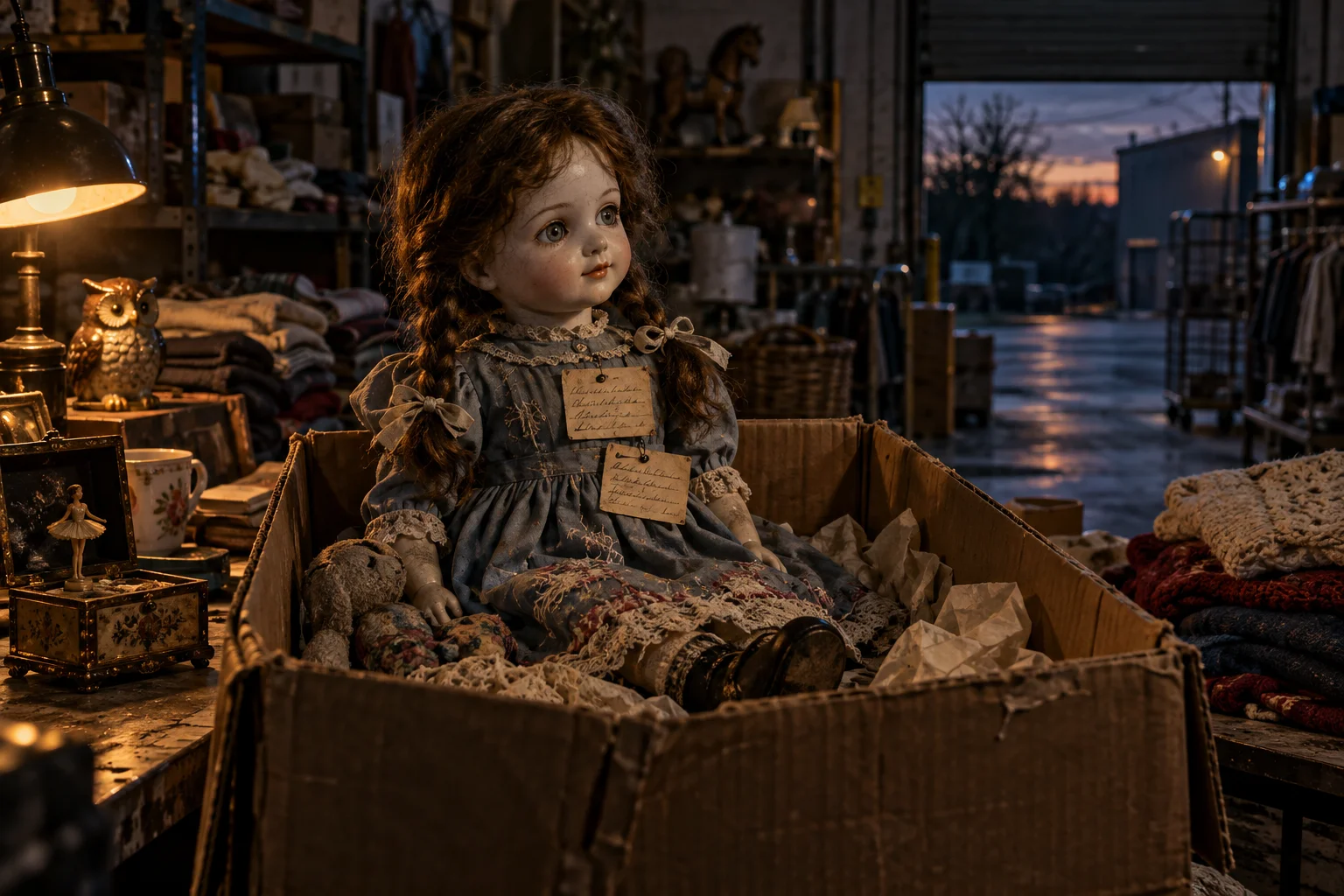
The doll came back on a Tuesday, which was how Nora knew something was wrong. Donations at the Second Chances thrift store arrived on weekends, in trash bags and banana boxes left by the back door. Tuesday was for sorting. Yet there she was when Nora unlocked the shop: a porcelain doll in a faded blue dress, sitting upright in an empty box as if she had been placed there for an interview. Pinned to her collar was an index card. Please don’t send her back.
Please don’t send her back
Nora had volunteered at Second Chances for three years, long enough to know that people donate the things they cannot bear to throw away. Wedding dresses still smelling of perfume. Hand-knitted sweaters with one sleeve unfinished. Boxes of letters tied with string, which the manager, Mr. Okafor, made her return to the address on the envelopes whenever she could find one. Objects carried stories. Most of the time the stories were sad in an ordinary way, and Nora had learned to fold them neatly and put a price sticker on them.
The doll did not feel ordinary. She was about eighteen inches tall, her porcelain face painted with a small, closed smile and eyes the pale gray of dishwater. Her hair was real, Nora thought, or a good imitation: brown, braided, tied with a ribbon that had been retied many times. The blue dress had been mended at the hem in at least four different colors of thread. Someone had cared for her, and then someone had stopped.
Nora turned the index card over. On the back, in faint pencil, was a date from the previous March and a second line in different handwriting: She was very good with our girls. Below that, a third hand had added, in ink pressed so hard it had torn the card: We are so sorry.
She set the doll on the sorting table and went to put the kettle on. When she came back, the doll was facing the door. Nora told herself that she had put her down that way. The table was crowded, and the floor in the back room sloped toward the loading door so badly that marbles rolled across it on their own. She turned the doll around, priced her at twelve dollars, and put her on the shelf of collectibles by the register, between a ceramic owl and a music box that no longer played.
A young couple bought her that afternoon. The woman held the doll up to the window and said she looked exactly like the one her grandmother had owned. Her husband paid in cash. Nora wrapped the doll in tissue, slid her into a paper bag, and watched them walk to their car. She felt a small, unprofessional relief, the kind she usually reserved for sweaters that had belonged to people who had died.
The following Tuesday, the doll was back in the box by the back door. Her ribbon had been retied. There was a new index card pinned beneath the old one. It said, in neat, rounded handwriting: She doesn’t like it when you turn her around.
The drawer of notes
Mr. Okafor did not laugh when Nora showed him the card. He looked at it for a long time, then unlocked the bottom drawer of his desk, the one that stuck in summer, and took out a shoebox. Inside were dozens of index cards, some yellowed, some bright white, a few on lined paper torn from school notebooks. Each had a hole near the top where a pin had gone through.
“She’s been coming back since before I bought the shop,” he said. “The old owner kept the cards. I kept them too. I didn’t know what else to do with them.” He rubbed his eyes. “Usually it’s once or twice a year. Somebody buys her, somebody brings her back. Once a week is new.”
Nora sat on an upturned crate and read the cards in order. The earliest were written with a fountain pen. She sings to the baby. She keeps the boys from fighting. She is very good with our girls. Then, slowly, the tone changed. Please don’t let her sit at the table. She doesn’t like the dog. Our son says she tells him what to do. Several cards were only apologies. One said, simply, She chose Emma. We are not strong enough.
“Did anyone ever call the police?” Nora asked. Mr. Okafor shrugged. “And tell them what? That a doll keeps getting donated?” He pointed at the cards. “Nobody writes what happened. They only write what they want the next family to know.”
That evening Nora searched online for the address of the young couple who had bought the doll. She found it from the receipt, where the woman had written her email for the store newsletter. The house was on Alder Street, four blocks from the shop. Nora told herself she was only walking past. The porch light was on. Through the front window she could see a high chair, a stack of baby clothes on the couch, and on the mantel, between two framed photographs, an empty space shaped exactly like a small, seated person.
The woman opened the door before Nora knocked. Her eyes were red. “You’re from the shop,” she said, and then, before Nora could answer: “She wanted to go back. She told our daughter she wanted to go back to you.” The woman’s daughter was eight months old. She did not talk yet. Nora asked how she knew what the doll had said, and the woman began to cry, quietly, holding the door frame. “Because now she won’t stop saying your name.”
Twelve dollars
Nora did not take the doll home. She left her on the shelf by the register and moved the ceramic owl so that the doll could see the door, because that seemed to be what she wanted and because Nora did not want to find out what happened if she was turned around again. She lowered the price to five dollars. Nobody bought her. Customers picked her up and put her down quickly, rubbing their fingers afterward as though the porcelain had been wet.
On Saturday a girl of about seven stood in front of the shelf for twenty minutes. Her mother was trying on coats. The girl did not touch the doll. She only stood very still, nodding sometimes, the way children nod when an adult is explaining something they do not understand. When her mother called her, the girl walked over to the register and said to Nora, very seriously, “She says you have to stop reading her letters.”
Nora locked the shoebox in Mr. Okafor’s desk that night and took the key home. At three in the morning her phone rang. The caller ID showed the shop’s landline. When she answered, she heard the music box from the collectibles shelf, the one that no longer played, turning out a lullaby slowly, as if someone were winding it with great patience. Under the music, a little girl was humming along. The humming stopped. A woman’s voice, very close to the receiver, said, “Twelve dollars was fair.”
In the morning the desk drawer was open and the shoebox was on Mr. Okafor’s chair. All of the cards had been unpinned and laid out on the floor in rows, oldest to newest, like a family tree. At the end of the last row there was a blank card with a pin already through it. Beside it lay a pencil from the register cup, its point freshly sharpened.
Mr. Okafor arrived at nine and stood in the doorway looking at the floor for a long time. Then he said the thing Nora had been afraid he would say. “She doesn’t want a new family. She wants someone to write the next card.” He would not look at the shelf. “Every person who kept her wrote one. Every person who wrote one gave her up. I think she’s asking you to skip the middle.”
The girls she was good with
Nora spent her lunch break at the county library, matching the names on the cards to the public records she could find. It was easier than she expected. People who write Please don’t send her back also tend to sign their names. There were births and moves and a handful of obituaries. There were no crimes, no missing children, nothing anyone could have taken to the police. But there was a pattern, and once she saw it she could not stop seeing it.
In every family, one child had been closer to the doll than the others. The cards called her the one she chose. And in every family, that child had grown up to be the person who brought the doll back. Not the parents. The children. Emma, whose parents had written We are not strong enough, had donated the doll at the age of forty-one, along with a card that said only: I’m sorry, I tried to keep her for you.
For you. Nora read the card again. She had assumed the you was the doll. But Emma had not been apologizing to the doll. She had been apologizing to whoever came next, the stranger who would open the box on a Tuesday, unpin the card and feel the small tug of obligation that Nora had felt. The cards were not warnings. They were a chain of people handing a responsibility forward, each one hoping the next would be stronger.
When Nora got back to the shop, the girl from Saturday was standing in front of the collectibles shelf again. Her mother was nowhere in sight. The doll had been turned to face the girl, and the girl was holding out her hand, palm up, the way you hold out your hand to a dog you have just met. Nora said the girl’s name without knowing how she knew it. The girl looked up, startled, and the spell broke. Her mother came around the corner, apologizing, holding two coats.
After they left, Nora took the doll down from the shelf. The porcelain was warm. Up close she could see that the doll’s painted smile was not closed after all. There was a hairline gap between the lips, as though she had been about to say something for a very long time and had decided, out of politeness, to wait.
The next card
Nora sat at the sorting table with the doll on her knee and the blank card in front of her. She thought about what she would write. She is very good with children was true, in its way. Please don’t send her back was the message everyone wanted to read. We are so sorry would be honest. None of them said what she now understood, which was that the doll did not hurt the children she chose. She simply stayed with them, all their lives, until they could no longer bear the company and passed her on to a stranger.
“What do you want?” Nora asked aloud, and felt foolish, and then did not feel foolish at all, because the music box on the shelf turned one note, very softly, in the empty shop. Nora looked at the shoebox. She looked at the rows of cards. Sixty-three of them, she had counted, spanning nearly a century. Sixty-three people who had loved the doll, or been loved by her, and then had not been strong enough.
She wrote, in careful block capitals: SHE IS LONELY. Then, beneath it: SHE WANTS SOMEONE WHO WILL NOT GIVE HER AWAY. She pinned the card to the doll’s collar, below all the others, and the doll’s weight in her lap changed, the way a sleeping child’s weight changes when it decides to trust you.
Nora took the doll home that night. She put her on the bookshelf in the living room, facing the door, and she did not turn her around. For three weeks nothing happened. The doll stayed where she was put. Nora’s phone did not ring at three in the morning. She began to think that perhaps the right card had finally been written, and that whatever had been waiting inside the porcelain had only needed someone to say its need out loud.
On the twenty-second day, Nora’s sister came to visit with her daughter, who was six. The girl went straight to the bookshelf and stood in front of it for a long time, nodding. When Nora asked what she was doing, the girl said, “She says you’re very kind.” Then she smiled, and Nora noticed for the first time that her niece’s smile was small and closed, with a hairline gap between the lips. “She says you can rest now,” the girl added. “She says she’ll come home with me.”
Nora’s sister laughed and said children say the strangest things. Nora did not laugh. She looked at the bookshelf, where the doll sat facing the door with all sixty-four cards pinned to her dress. Then she looked at her niece, who had already put on her coat and was waiting by the door, perfectly still, the way you wait for someone you have known a very long time.
Published by LiveLore · AI-assisted fiction · human-reviewed
Join the story-update list below. Email dispatches have no confirmed schedule; you can remove your address using your private unsubscribe link.
← Back to the stories