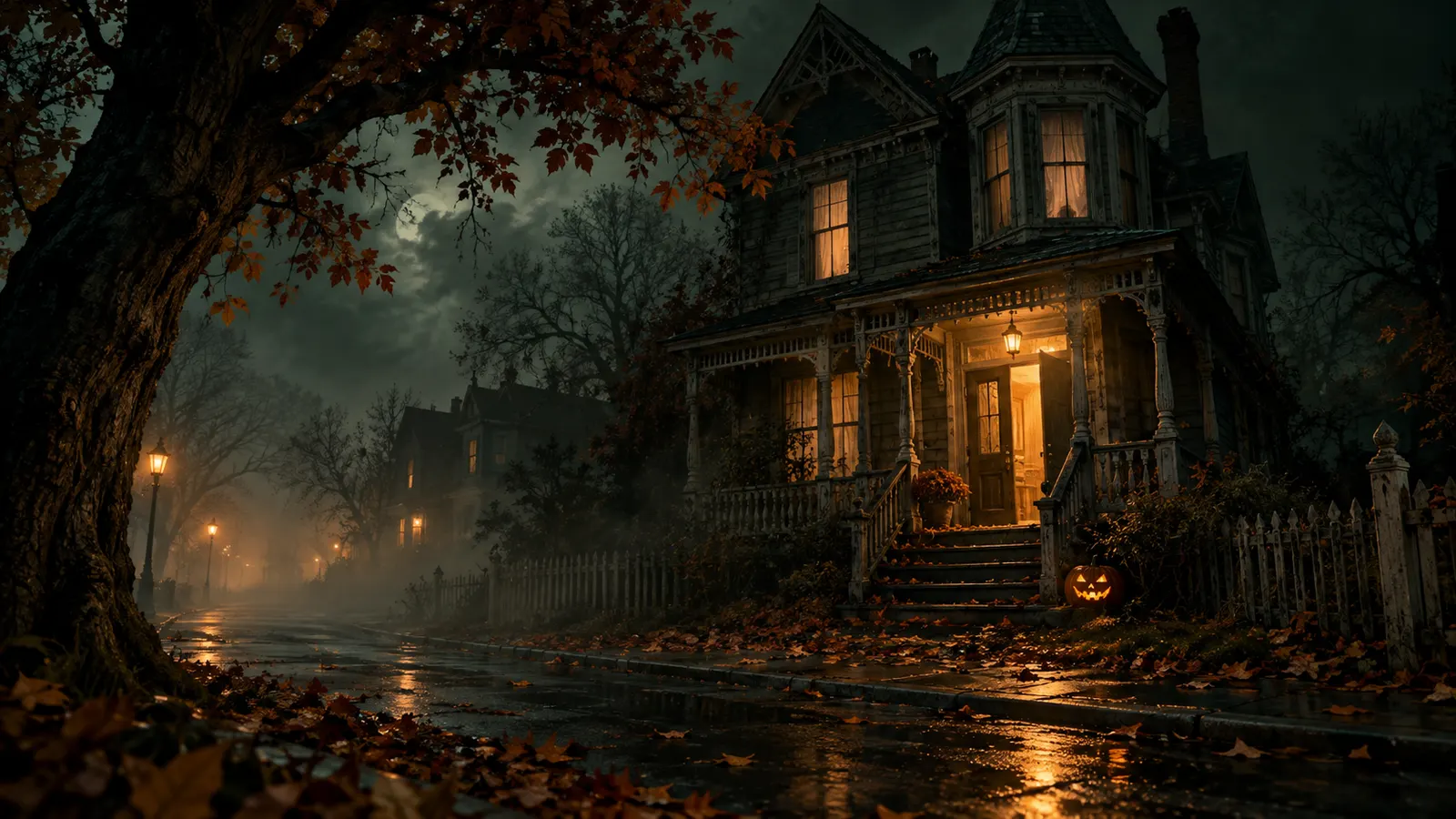
The rule had been passed down by every generation of Maple Street kids the way other towns pass down football scores: take your candy from the first ten houses, and never, never knock on the last one. Lily, who had moved in that August, asked why. No one would say. So on Halloween night, with her bag half full and her courage half empty, she walked to the end of the street anyway.
The eleventh porch
She wasn’t trying to be brave. Her little brother had a fever, and she had promised him one piece of candy from every house. Ten houses meant ten pieces. Theo knew how to count, and he knew there were eleven porches between their driveway and the empty lot. Lily had explained the rule to him before leaving. “Maybe they just don’t like sharing,” he had said. That seemed as possible as anything the older kids refused to tell her.
The last house had a porch light on. This was the first thing she noticed. No broken windows, no sagging roof, no weeds tall enough to hide a person. A jack-o-lantern stood beside the steps with a patient, ordinary smile. Through the curtains she could see a room full of warm light. Somebody had swept the fallen leaves into two neat piles beside the walkway.
Behind her, the other children stopped at the tenth mailbox. A boy dressed as an astronaut called her name. When she turned, he was already backing away. Lily waved as if she had decided to do this long ago. Then she climbed three wooden steps and knocked. The door opened before she finished lowering her hand. An elderly woman stood there holding a bowl of wrapped sweets.
“One for you,” the woman said, “and one for your brother.” Lily had not mentioned Theo. The woman must have seen them moving in. Everybody on the street seemed to know which child belonged to which house. She wore a dark cardigan and a paper crown cut from a grocery bag. Her face was kind in the practiced way of someone who had welcomed many children.
Lily thanked her and reached into the bowl. The wrappers were plain gold paper, folded at each end. As she took two pieces, she heard something click inside the house. A clock, perhaps. The woman looked past her toward the street. “That’s everyone,” she said. Lily turned. The astronaut and the other children were gone. Every porch light except this one had gone out.
The names on the wrappers
She hurried down the steps and found the walkway longer than she remembered. Leaves shifted under her shoes, though the woman had swept them aside. At the gate, Lily tried to call her mother. The phone showed the right time, the right battery level, and no contacts. She could remember her mother’s number until she opened the keypad. Then she could remember only the first three digits.
A small hand touched her sleeve. A girl in a cardboard butterfly costume stood beside the mailbox. The paint on her wings had faded to the color of old newspapers. “Did you eat it?” she asked. Lily shook her head. The girl held out her own candy. Under the fold in the gold wrapper, a name had been printed in black: Ruth Bellamy, October 31, 1987.
Lily unfolded one of her wrappers without opening the candy. Her own name was there, followed by that night’s date. On the other was Theo’s. His name looked smaller, as if whoever printed it had allowed room for it to grow. The butterfly girl said she should keep the wrappers. “If you lose the name,” she said, “you forget which door is yours.”
Lily asked where her parents were. The girl pointed down Maple Street. Houses stood on both sides now, stretching farther than Lily could see. Each had the same porch, the same smiling pumpkin, the same bowl visible through an open door. A child waited beside every gate. Their costumes belonged to different years: plastic masks, homemade capes, a bright silver suit sewn from something that crinkled when its wearer moved.
“They come looking,” the girl said. “Usually after the first hour. But they look on their street, and we’re on hers.” From the porch behind them, the woman called that there was plenty for everyone. Ruth’s wings trembled. Lily looked at the unopened candy for Theo and imagined him waiting in bed, watching the clock because she had promised she would be home before nine.
A place at the table
Inside, a long table ran from the front room into a hallway Lily had not seen from the door. Paper plates waited at each place. On every plate lay a folded crown. The woman had added two more chairs at the end, one full-sized and one with a cushion. Lily stopped just inside the doorway, keeping both pieces of candy clenched in her hand.
“I’m taking these home,” she said. The woman smiled. “Of course. Everyone takes something home.” She pointed toward a wall covered in photographs. Children stood on this porch in groups, holding their bags up for the camera. Lily found Ruth in one picture, wings bright and new. In another she saw the boy in the astronaut suit. The photograph was dated thirty years before he could have been born.
He had been standing beside Lily an hour ago. He had told her the rule. She turned to find him at the far end of the table, helmet tucked beneath his arm. “They let one of us go back each year,” he said. “To tell the others. Nobody listens if you tell them why.” He looked at the two new chairs and shook his head. “You weren’t supposed to bring someone who wasn’t here.”
The woman placed a small cup beside Theo’s plate. A line of steam rose from it. Lily could smell the medicine her mother stirred into apple juice when Theo was ill. The woman was setting the table for him with the same care she had used to sweep the path. That made Lily angrier than if she had laughed. “He didn’t knock,” she said. “I did.”
The woman’s smile faded. For the first time she looked old rather than merely dressed like someone old. “You asked for him,” she said. Lily remembered the words on the porch. One for you, and one for your brother. The woman had offered. Lily had only accepted. She said this aloud. All along the table, the children lifted their faces toward her.
The first Halloween
Ruth slid a photograph across the table. It showed the house before the street had a name, standing alone beside bare fields. A young woman waited on the porch with a bowl in her hands. Beside her stood a boy wearing a paper crown. The woman in the room reached for the photograph, but Lily held it against her chest. On the back was a message: First Halloween home. Let no child go away empty-handed.
The boy had died before the next October. Lily learned that from the newspaper clipping folded behind the frame. The house had remained dark for years. When its porch light finally came on again, every child who knocked was welcomed inside, and every parent who came looking found an empty building. The rule had grown around the absence, passed from child to child because the adults could not agree on what had happened.
“You could let us leave,” Lily said. The woman looked at the paper crown on the empty plate nearest her. “Then he might come back to an empty house.” Lily thought of Theo waiting for her and understood enough to feel sorry. Understanding did not make the locked street any less wrong. The room seemed to wait for her to confuse one thing with the other.
She laid the clipping beside the woman’s bowl. “You don’t get to keep somebody else.” Somewhere upstairs, a door slammed. The house lost its warmth for a moment. Through the windows Lily could see her own street again, her mother standing beneath the tenth porch with a flashlight. Lily shouted, but the glass reflected her voice back into the room as a child’s delighted laugh.
The woman turned toward the sound. Her expression softened. She thought the laugh had come from upstairs. For a few seconds nobody watched Lily. The astronaut boy pointed toward a narrow hallway behind the stairs. There were doors along it, each bearing a child’s name. At the far end, the paint on one panel was still drying. LILY. Beneath it, in smaller letters, THEO.
One more piece
The gold paper in Lily’s hand began to warm. She could hear her brother coughing behind the new door. It was the small deliberate cough he made when he wanted someone to know he was awake. She took a step toward it. Ruth caught her wrist. “It knows what will make you open it,” she said. “Mine was my dog.” The girl’s hand was cold, but it was solid.
At the front of the house, the gate swung open. Beyond it lay the real street, lit by flashlights and moving shadows. The astronaut boy began guiding the other children toward it. The woman stood beneath the photographs, listening to a noise from upstairs that sounded more and more like a boy running home. On the mantel, the clock’s hands moved toward midnight, though Lily’s phone still read eight forty-nine.
She could return the candy. The words on the old photograph promised that no child would go away empty-handed; perhaps giving something back would break the promise that held them. She could open the door with her name on it and find out whether Theo was really inside. Or she could join the children at the gate while the woman was looking elsewhere. Each possibility left someone waiting.
“Lily?” came the voice behind the door. On the porch, her mother called the same name. In the bowl, one last piece of gold-wrapped candy turned slowly as though something beneath it had taken a breath. The woman looked up. “Before you go,” she said, “did you save one for my boy?” Lily held her brother’s candy tight enough to feel its edges through the paper. The clock began to strike.
Published by LiveLore · AI-assisted fiction · human-reviewed
Join the story-update list below. Email dispatches have no confirmed schedule; you can remove your address using your private unsubscribe link.
← Back to the stories