Three people leave the trail
We went camping the weekend before Halloween because Eli said the campground would be empty. He was right about the campground. He was wrong about what that meant. We left the trail at four, carrying enough food for three people and a tent we had not used since college. Ruth carried the map. I carried the stove. Eli carried a photograph he refused to explain until after dark.
The ranger at the parking lot asked us to sign a sheet. There were three lines. I wrote my name, Ruth wrote hers, and Eli made a joke about liability. The ranger did not smile. He asked whether we planned to have a fire. When Eli said yes, the ranger tore the bottom off the sheet and handed it to him. “Don’t count the voices,” he said. “Just keep the conversation moving.”
We assumed it was a local joke. Halloween was in the windows of every shop in town, and the gas station sold bundles of firewood tied with plastic skeleton hands. Eli had a talent for making other people’s seriousness seem like performance. He thanked the ranger for the warning and asked whether ghosts preferred marshmallows toasted or burnt. The ranger looked at me instead of him.
“If someone tells a story you remember differently,” he said, “let them finish.” Then he returned to his truck. Ruth watched until the truck disappeared around the bend. She wanted to choose another trail. Eli reminded her that we had driven four hours. I said the weather would hold and the campsite was only two miles in. That is the part I keep returning to: how reasonable we sounded.
The campsite lay in a shallow hollow beside a river we could hear but could not see. Three flat stones surrounded an old fire ring. We put the tent between two pines and hung the food well away from it. Eli collected fallen branches. Ruth unfolded the map on a stone and traced our route with one finger. She frowned, then folded it before I could ask why.
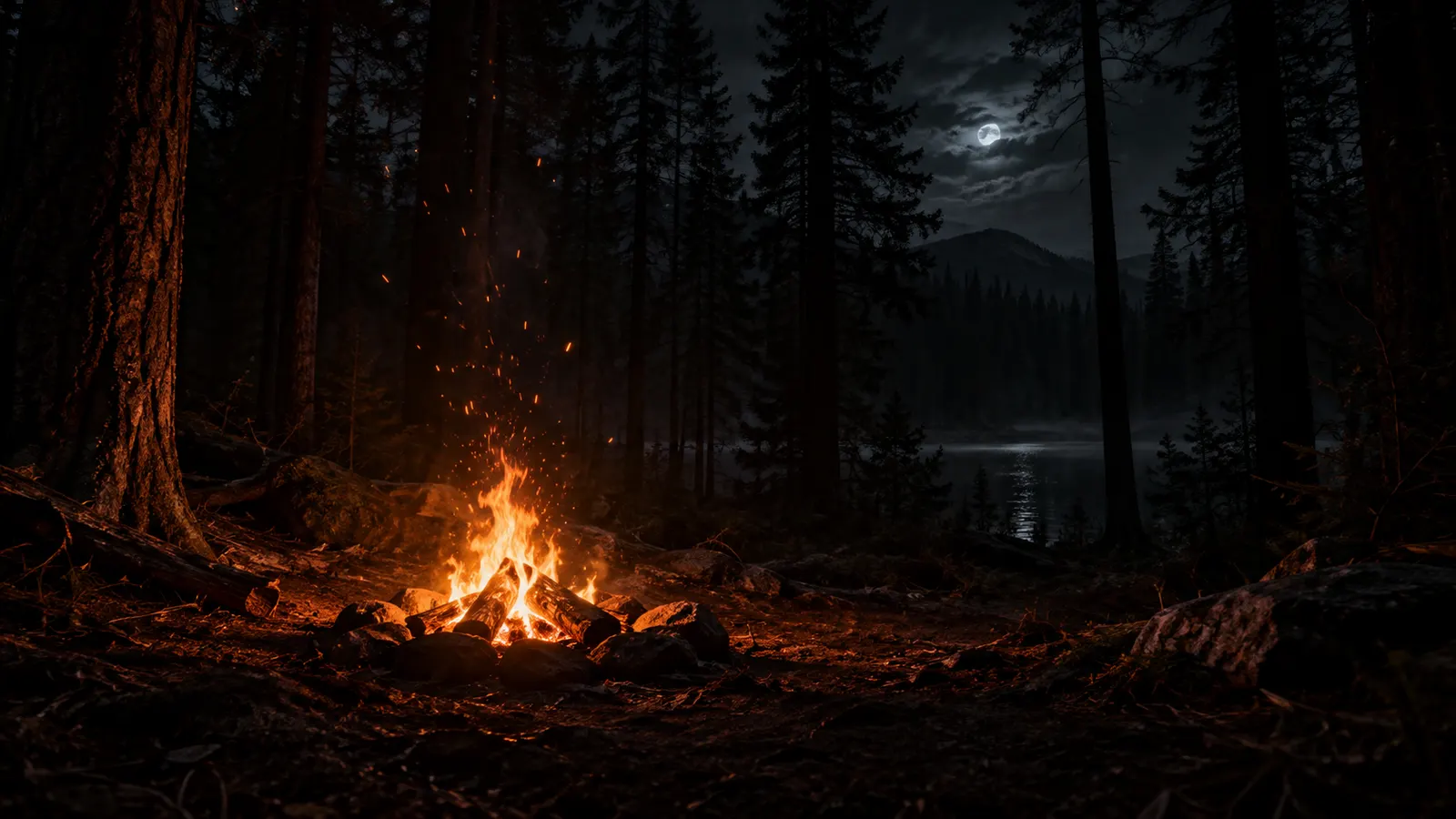
At dusk, we lit the fire. It took on the first match. Eli said that was a good sign. Behind us, in the direction of the river, a branch broke. Not the crack of an animal stepping carelessly. A slow break, bent until the fibers gave one by one. Ruth looked up from her cup. Eli threw another stick onto the flames and asked who wanted to tell the first story.
A story with an extra seat
I told the one about the woman driving home who saw a man crouched in her back seat. We all knew it. That was why I chose it. A familiar story would turn the hollow into an ordinary campsite, the kind where friends interrupted each other over details. Ruth corrected the color of the car. Eli insisted the warning came from a gas station attendant. Someone on my left laughed.
Ruth was on my right. Eli sat opposite me. I kept talking. The laugh had been brief, almost friendly, and the ranger’s words came back with an unpleasant precision. Don’t count the voices. I looked at the fire instead of the empty place beside me. When I reached the ending, a low voice said, “That isn’t how she died.” It sounded as if it were speaking through a scarf.
Eli opened his mouth. Ruth kicked his boot so sharply that sparks jumped from the fire ring. “Your turn,” she said to him. He stared at her, then at me. I gave the smallest nod I could manage. He began a story about our first camping trip in college. The time we lost the car keys and had to walk to a farmhouse to use the phone.
We had not lost the keys. They had fallen into the river. I remembered watching them turn beneath the surface, little silver fish beyond the reach of my fingers. But Eli said we left them on a picnic table, and Ruth stared at the flames without correcting him. The low voice made an approving sound. A fourth stone appeared at the edge of my vision. I kept my head still.
Eli said a woman at the farmhouse invited us inside. This was new. We had used a payphone outside a closed grocery store. He described wallpaper covered in green birds, a dog asleep under a kitchen table, a bowl of apples. As he talked, I could see the kitchen. I could remember the dog lifting its head. My memory of the payphone became thin and colorless.
Ruth pressed her thumb into her palm hard enough to leave a white crescent. “And we got home,” she said, when Eli paused. “Eventually,” said the voice. Eli’s face changed. He looked down at his own hands, turning them over as if he had put on gloves without noticing. Beyond the firelight, the river stopped making noise. Not gradually. It stopped in the middle of a splash.
The person in the photograph
Eli took out the photograph. He did it slowly, keeping his eyes on the fire. Three of us stood at this same campsite, younger, in clothes I recognized. The date on the back was October 2016. We had never camped here before. In the photograph, my arm curved around an empty space. Ruth was holding a cup out to someone just beyond the right edge.
“I found it in my father’s things,” Eli said. “After we cleared the house.” His father had died that summer. I had helped carry boxes to the car. I remembered a carton marked CAMPING, and the way Eli had closed it when I reached for the lid. “There was a name on the envelope,” he said. The low voice breathed in. Ruth said, “Don’t.”
He stopped. A shadow stretched across the photograph, though nothing had moved between it and the fire. I could see four shadows on the ground without counting them. The distinction felt childish and necessary. One had its head tilted in the wrong direction, toward the dark rather than toward the flames. It lay close enough to my shoe that I wanted to lift my feet.
The voice told us about a boy who went camping with his friends. They had promised to wait while he crossed the river for more wood. They had heard him call once and thought he was joking. When he called again, his voice sounded different. They packed the tent before dawn. Nobody said the boy’s name on the walk back. By the time they reached the car, there were only three places to remember.
I wanted to say we would never do that. Instead, I tasted river water. My socks felt wet inside my boots. Ruth was crying quietly, her face motionless except for the tears. Eli stared at the photograph. In it, the empty space beneath my arm was no longer empty. There was a sleeve, dark green, ending in a hand that held a bundle of sticks.
“Let him finish,” Ruth whispered. The voice continued. The boy waited by the river. He learned the sounds of the woods. He learned that people returned to places where they had left parts of themselves. Eventually, he learned to sound like someone they might want to hear. When it said this, its voice became my father’s. Not his words or accent. His small intake of breath before saying my name.
Who gets to go home
The fire sank lower. Eli reached for the woodpile, but Ruth caught his wrist. Every stick beside the ring was wet. Water beaded on the bark and ran between the stones toward the empty seat. I looked at the bundle in the photograph. The same forked branch lay on top. The hand holding it wore a watch with a cracked face. I knew that watch. I had given it to someone.
The memory hurt before it arrived. A birthday in a dorm room. Cheap cake on paper plates. Somebody laughing because the strap was too large. I could remember the laugh, the green sleeve, the smell of rain on a jacket. I could not remember the face. The low voice asked whether we wanted another story. Ruth said no so softly that the word barely made it across the fire.
“Then tell me mine,” it answered. Eli turned the photograph over. The date had been joined by a line of handwriting. Four names. Three were ours. The fourth seemed to slide whenever I looked directly at it. I read the first letter and felt my shoe fill with cold water. Ruth pulled the photograph away and laid it face down on her knee.
She said there might never have been a boy. Maybe the story wanted one, and we had supplied a birthday, a watch, a laugh. Maybe it made room for itself by teaching us to feel guilty. I wanted to believe her. Then she asked why I had brought four cups. I opened the bag beside my feet. There were four tin cups inside. I had packed three. I remembered packing four. Both memories were complete.
The fire made a hollow sound, as though burning above a deep shaft. Through the coals, I saw moving water. The river had not become silent. It had moved underneath us. Beyond the trees, a flashlight blinked twice. The ranger called that we should follow the water downhill. The voice beside me said the ranger had been dead for ten years. Eli started to answer, then shut his mouth.
Ruth placed the photograph in my hand. The missing name was almost readable now. If I spoke it, perhaps we would remember our friend. If we broke the circle, perhaps the night would forget us. Or we could give the voice what it had been asking for all along: a turn without interruption. Across the fire, Eli waited. To my right, Ruth held her breath. On my left, someone drew their wet sleeves close to the warmth.
Published by LiveLore · AI-assisted fiction · human-reviewed
Join the story-update list below. Email dispatches have no confirmed schedule; you can remove your address using your private unsubscribe link.
← Back to the stories