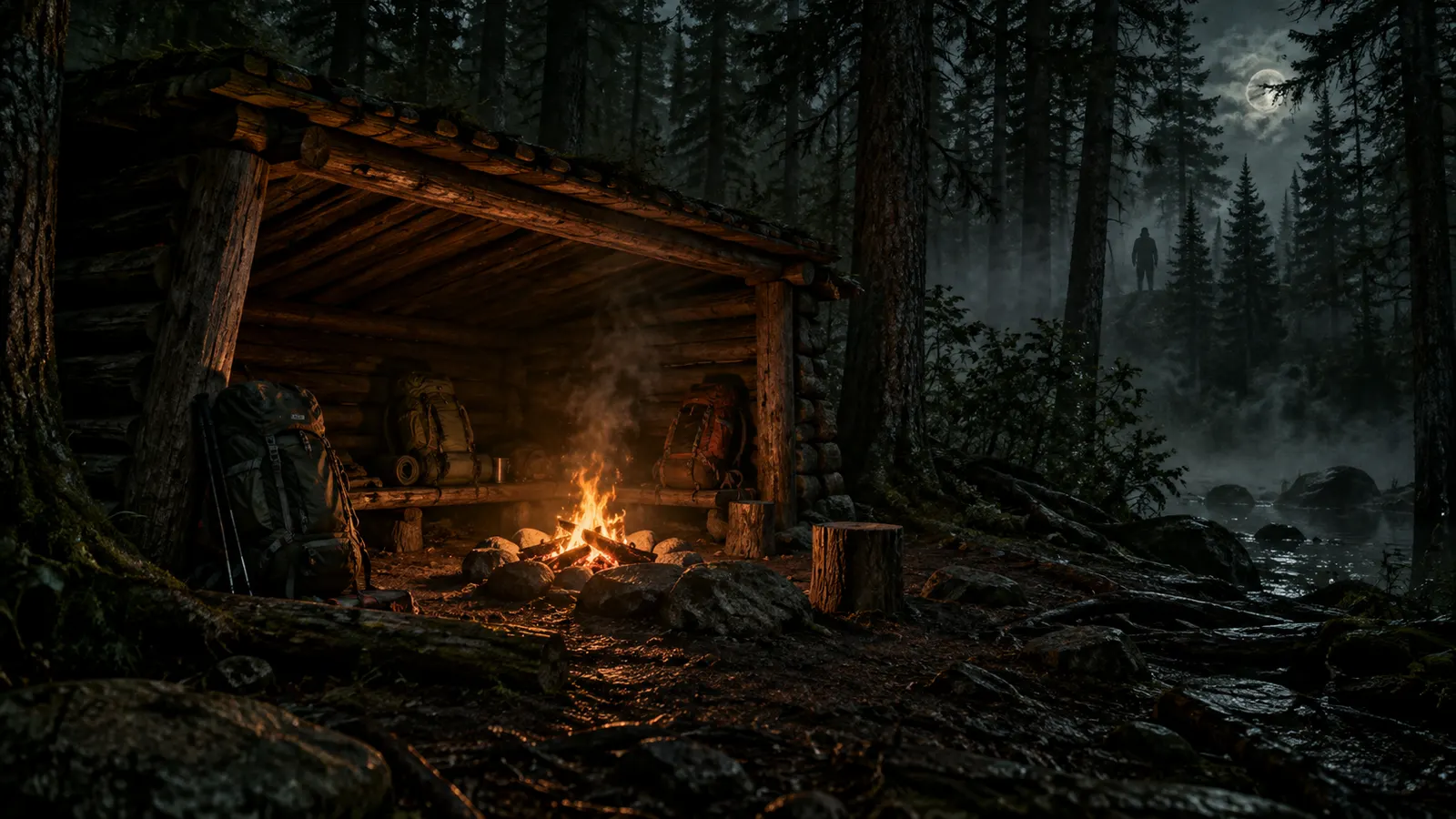
"I’ve told this once," my uncle said, feeding the fire, "and I’ll tell it one last time." It happened on the Appalachian Trail in ’09, at a lean-to near mile 9. He and two friends had the shelter to themselves until, from the tree line, a man’s voice began to count. "One." A pause. "Two." A pause. "Three." Then nothing. In the morning a ranger asked how many had been in their group. "Three," they said. The ranger went pale. "Then who was the fourth one I saw standing at the tree line?"
The part he usually left out
That was where he stopped when I was a kid. He’d grin, throw another log on, and ask who needed the bathroom. We thought the ranger was the punch line. This time he didn’t grin. He took the kettle off the flames and set out four cups, though there were only three of us around the fire. My cousin and I looked at each other. Uncle Ray noticed, but he didn’t put one away.
“Mile nine from where we parked,” he said. “Not an official trail marker. People always get that wrong.” He wanted us to understand that he hadn’t set off looking for a particular shelter or a place with a story attached. There had been rain coming. He and Ben and Lewis were tired. They took the first lean-to they reached because that was what you did when your socks were wet.
Ben had the map. Lewis had an expensive camera he mostly used to photograph his dinner. Ray carried the food and complained about carrying the food, as he had on every trip since they were eighteen. He said that detail mattered. They knew each other’s bad jokes, knew whose knees would hurt on a descent, knew the exact length of silence before someone apologized. There wasn’t room for a stranger to hide among them.
The shelter smelled of damp leaves and old smoke. A notebook sat in a plastic bag under one of the roof beams. People had written about mice, weather, blisters. On the last page, somebody had drawn three short vertical strokes and a fourth running sideways through them. Ben said it was an unfinished tally. Lewis said it looked finished to him. Neither explanation seemed worth remembering then.
One, two, three
Ray told us to picture a voice coming from beyond the firelight. Not a growl, not a whisper. A tired man trying to count something without losing his place. “One.” They looked up. “Two.” Lewis stood with his headlamp aimed toward the trees. “Three.” Ben called out that there was room in the shelter. Ray said that was the mistake he kept coming back to, though none of them knew it yet.
Nobody answered. The beam showed rain on leaves and the bright eyes of something small close to the ground. Lewis walked ten steps out, called again, then came back. They finished eating. They agreed it had been another hiker making sure nobody was hurt. Ray cleaned the pot and hung the food bag. By the time he lay down, the explanation felt almost like a memory.
He woke because someone was turning pages. Ben lay to his right. Lewis lay beyond him. Both were asleep. At the open edge of the shelter, the register rested on a pack Ray did not recognize. He could see the pages lifting one by one even though the air was still. He kept looking at the unfamiliar pack because looking above it would have meant looking at whoever was holding the notebook.
A voice said, “One.” Ray shut his eyes. “Two.” He felt the wooden floor flex under a careful footstep. “Three.” The silence afterward was worse than another number. In that silence he could hear Ben snoring, Lewis breathing through his mouth, and someone breathing beside his own head. Ray said he lay there until morning without moving, holding every number he knew behind his teeth.
The ranger’s question
At dawn, the extra pack was gone. The notebook sat in its bag beneath the beam. Ray did not mention waking up. He thought the others might say he’d been dreaming, and he thought they might say they had heard it too. He wasn’t sure which answer frightened him more. They ate oatmeal, packed their sleeping bags, and found the ranger standing where the path left the clearing.
The ranger asked about their group. That was the part Ray had told us before. Three, they said. The man went pale and asked about the fourth figure at the tree line. Ben laughed once, uncertainly, then stopped. “Another hiker?” he suggested. The ranger looked at the shelter rather than at them. “Was he invited in?” Nobody answered quickly enough.
Ray wanted to know why the ranger hadn’t approached the man. “I thought he was waiting for you,” the ranger said. “He was wearing your coat.” Ray looked down. His red raincoat was zipped around him. He had slept in it. The ranger described the strip of silver tape on one sleeve, where Ray had patched a tear. Then he asked them to count their belongings, but not each other.
There were three sleeping bags, three packs, and four cups. Lewis insisted he had brought a spare. Ben said Lewis never carried anything spare. Ray knew the fourth cup: a green enamel one with a chipped rim that had belonged to his father. He’d lost it on a camping trip when he was fourteen. He picked it up and felt, for one ridiculous second, grateful to have it back.
The walk downhill
The ranger said they should leave together and keep talking until they reached the road. It didn’t matter what they said. Directions, arguments, anything that belonged to the three of them. Ben wanted an explanation. The ranger pointed toward the trees and said explanations could wait. Ray left the green cup on the shelter floor. When they reached the first switchback, it was hanging from his pack.
They talked about college. Lewis described an apartment with a broken stove. Ben corrected him about the street. Ray talked over both of them about the year they all went to the wrong wedding reception. He said they sounded drunk with exhaustion, laughing too loudly and refusing to let a sentence end. Behind them, something kept the pace without making any sound on the wet leaves.
At a stream crossing, Lewis stopped. His camera had switched itself on. On its little screen was a picture of the shelter taken during the night. Three sleeping bags lay on the boards. Beside them stood a man in a red coat, his back to the camera. Lewis scrolled to the next picture. The same scene, closer. Then closer still. In the final frame, the man’s hand rested on Ray’s shoulder.
“Who took them?” my cousin asked. Uncle Ray shook his head. “You’re asking the same question we did. That’s why we stopped talking.” He turned his empty cup between his hands. In the forest above the stream, the voice counted again. One. Two. Three. Then it said Ben’s name. Ray would not repeat the way it sounded. He only told us that Ben answered before anyone could stop him.
What came back
The ranger caught Ben by the sleeve. Ray heard fabric tear, a sound so small and ordinary that it survived where the rest of the memory would not. Ben was on the far bank one moment and beside them the next. His coat had a long rip at the wrist. He said he had slipped. He said the ranger had pulled him back. None of them remembered seeing him fall.
At the road, the ranger asked them to write their names on separate pieces of paper. Ray wrote Raymond Walsh. Lewis wrote Lewis Bell. Ben stared at his page, pen hovering. After a while he laughed and asked whether they were being charged for camping in the wrong place. The ranger gave him another sheet. Ben wrote his first name three times, each in a different hand.
They drove home without Ben. Ray said this so quietly that I nearly missed it. The ranger stayed with him at the trailhead and told the others to contact his family. By the time someone came back, the parking lot was empty. Ben’s mother received a postcard every October for six years. Each showed a different shelter. Each said the same thing: Nearly caught up. Save me a place.
I asked why we had never heard of Ben. Ray looked at the fourth cup. “You have,” he said. “You just don’t remember it the same way.” He took out a photograph of a camping trip from my childhood. I recognized my orange jacket and my cousin’s gap-toothed smile. Behind us stood Uncle Ray, one hand lifted toward a man at the edge of the frame. Only a torn sleeve was visible.
One last time
The fire had burned low while he talked. Beyond our campsite, branches moved though the evening was still. My cousin picked up the kettle, perhaps to make tea, perhaps because holding something seemed better than having empty hands. Ray asked her to leave the fourth cup where it was. He had told the story once before, he said, to the person who wrote the last postcard. Tonight he wanted witnesses.
A light appeared on the path behind us. Someone called that he was a ranger and asked how many were camping. Ray did not turn. Neither did my cousin. The voice was friendly and a little out of breath, as if the man had climbed quickly to warn us about weather. I looked at the empty cup, then at the photograph in Ray’s hand. The torn sleeve was gone from its edge.
From the trees opposite the path came a different voice. “One.” Ray reached for the shelter register he had carried in his bag all these years. “Two.” My cousin set the kettle down without a sound. “Three.” The ranger’s light stopped moving. He asked the question again. Ray looked at me, and I understood why he had brought four cups. This time, he meant to find out who had been counted.
Published by LiveLore · AI-assisted fiction · human-reviewed
Join the story-update list below. Email dispatches have no confirmed schedule; you can remove your address using your private unsubscribe link.
← Back to the stories